
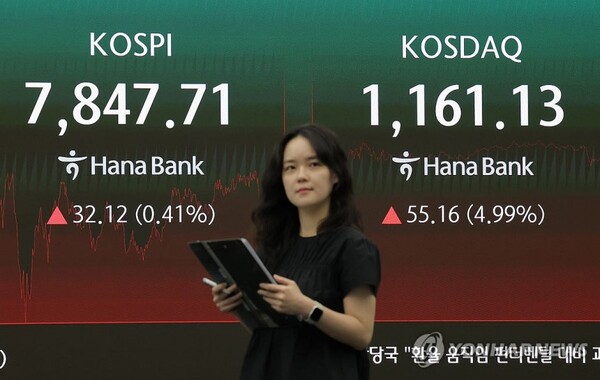
[DigitalToday reporter Oh Sang-yup] South Korea's Kosdaq index surged nearly 5 percent on Thursday on joint buying by foreign investors and institutions. In the KOSPI market, heavy net selling by foreigners continued, but the Kosdaq posted net buying for a sixth straight session, underscoring a clear split in flows between the two markets.
According to the Korea Exchange on Thursday, the KOSPI closed up 32.12 points, or 0.41 percent, at 7,847.71. It opened at 7,873.12 and rose as high as 7,886.64, but gave up some gains under foreign selling pressure.
In the main board market, retail investors and institutions posted net buying of 1.07 trillion won and 758.5 billion won, respectively. Foreigners, however, were net sellers of 1.92 trillion won, capping the index. Turnover stood at about 30.48 trillion won.
Pressure from the won-dollar exchange rate also persisted. The won fell to 1,517.90 per dollar, up 12.40 won, or 0.82 percent, from the previous day. The high exchange-rate trend added to the burden on foreign flows, triggering profit-taking pressure in KOSPI heavyweights.
Top market-cap stocks were mixed. Samsung Electronics fell 2.34 percent to 292,500 won, and Hyundai Motor slipped 1.65 percent.
SK Hynix rose 0.05 percent to 1,941,000 won, while Samsung Electro-Mechanics jumped 11.30 percent. Samsung Life Insurance, Doosan Enerbility and HD Hyundai Heavy Industries also rose.
The Kosdaq closed up 55.16 points, or 4.99 percent, at 1,161.13.
On the Kosdaq, foreigners and institutions posted net buying of 597.4 billion won and 287.8 billion won, respectively. Foreigners are seen as extending net buying in the Kosdaq market to 6 consecutive sessions through Thursday.
Foreigners are reported to have been net sellers of more than 100 trillion won in the KOSPI market so far this year, while posting net buying of more than 3 trillion won in the Kosdaq.
After a large-cap-led KOSPI rally raised valuation pressure, some funds appear to be moving into Kosdaq growth stocks and policy beneficiary shares.
On the Kosdaq, a buy-sidecar was triggered for a second straight day. The move came as expectations for the launch of the National Growth Fund combined with foreign and institutional buying, driving a simultaneous surge in Kosdaq 150 futures and cash markets.
With a sidecar triggered again on Thursday after the previous day, investment sentiment in small and mid-sized growth stocks showed signs of a rapid rebound.
The retail-participation National Growth Fund, which began sales on Thursday, also supported the Kosdaq's strength. The fund will be set up at 720 billion won, combining 600 billion won in public money and 120 billion won in government fiscal funds. Sales channels such as banks and brokerages were said to have quickly sold out most allocations shortly after launch.
The National Growth Fund is structured to invest in companies and related ecosystem firms tied to advanced strategic industries such as semiconductors, artificial intelligence, biotech, robotics and defence.
In particular, it will invest a certain share or more in unlisted firms and Kosdaq companies listed under the technology special listing track, lifting expectations for funding supplies to Kosdaq growth companies.
By sector, biotech, secondary batteries, robotics and quantum computing-related shares were strong. Buying flowed into growth sectors that align with the National Growth Fund's investment targets, widening the index's gains. Expectations for U.S. administration support for quantum computing and for the launch of related exchange-traded funds also affected investor sentiment.
Brokerage analysts say the fund's size alone will be unlikely to move the entire market, but it could be a meaningful signal for Kosdaq growth companies when factoring in expectations for follow-on policy-fund-type vehicles. Companies with high shares of research and development and capital expenditure are cited as potential beneficiaries.
Still, the possibility of increased volatility remains after the short-term surge. The National Growth Fund does not guarantee principal, and it may take time before actual capital deployment.
Recent sharp gains in the Kosdaq also reflect a short-term reaction combining policy expectations and improved flows, prompting calls for careful selection by sector.
Yeom Dong-chan (염동찬), an analyst at Korea Investment & Securities, said, "The retail-participation fund is not large, but benefits are expected for Kosdaq companies given that policy-fund-type injections are also being prepared." He added, "In particular, biotech firms are likely to be included in the investment targets in large numbers."
 Oh Sang-yup
yub@d-today.co.kr
Oh Sang-yup
yub@d-today.co.kr