
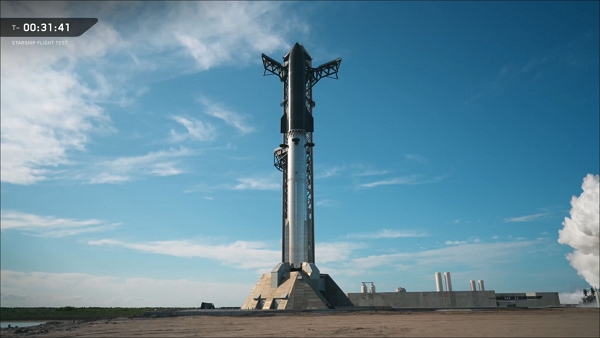
SpaceX is preparing the 12th test flight of its next-generation heavy spacecraft, Starship.
On May 21 (local time), CNBC and Ars Technica reported that SpaceX, ahead of an initial public offering (IPO), is pushing for the first launch of Starship V3 with significantly upgraded performance. The launch was delayed by a day due to a technical issue at the launch pad, and it is expected to be a key turning point for space businesses such as lunar exploration and Starlink satellite deployment.
The launch, initially scheduled for May 21, was halted with 40 seconds left in the countdown. That was because a hydraulic pin on the umbilical arm linking the launch tower and rocket did not retract properly. After a total of five holds, the launch was cancelled, and SpaceX plans to try again at 5:30 p.m. CT on May 22 once it resolves the issue.
Starship V3, making its debut, is designed as a fully reusable system capable of carrying 100 metric tons of payload to Earth orbit. It stands about 124 metres tall and produces 18 million pounds of thrust, about 81.6 million newtons. Unlike earlier versions, it has 39 Raptor engines with improved efficiency and a redesigned propulsion system. It also applies three large grid fins and permanently attaches a hot staging ring at the top.
The flight plan is similar to previous ones but some routes have been adjusted. The rocket will fly south over the Gulf of Mexico, passing between the Yucatan peninsula and western Cuba. About 2 minutes 30 seconds after launch, the Super Heavy booster will separate and splash down off the Texas coast. The upper spacecraft will then fly halfway around the Earth and re-enter the atmosphere over the Indian Ocean about 48 minutes after launch. The final objective is a precise splashdown offshore in northwestern Australia.
After entering space, it will deploy 20 dummy Starlink satellites for performance verification and 2 deployable Starlink satellites equipped with cameras. The V3 model modified its payload deployment mechanism to release satellites at a faster rate. This demonstration will serve as a stepping stone for operational satellite launches scheduled as early as late this year.
This test flight appears to be the last chance to demonstrate capability to investors ahead of SpaceX's IPO expected next month. Last year, SpaceX's space segment posted revenue of $4.1 billion and an operating loss of $657 million. By contrast, the connectivity segment including Starlink recorded revenue of $11.4 billion and operating profit of $4.4 billion, driving overall company profitability. Starlink revenue accounted for 61 percent of total revenue last year and 69 percent of revenue in the first quarter of this year.
NASA also plans to use Starship as a lunar lander for the Artemis IV mission scheduled for early 2028. The Artemis program aims for the first crewed lunar exploration in about 50 years and is also considered a key project in the United States' space leadership strategy.
The hydraulic pin holding the tower arm in place did not retract. If that can be fixed tonight, there will be another launch attempt tomorrow at 5:30 CT. https://t.co/DJAdvDYQpH
 Kyung-min Hong
hongm@d-today.co.kr
Kyung-min Hong
hongm@d-today.co.kr