
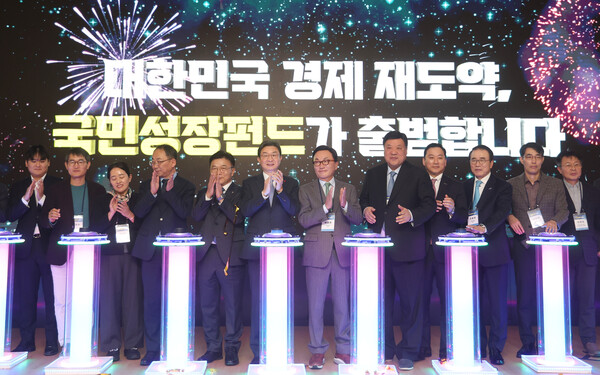
[Digital Today reporter Sangyeop Oh] A public-participation national growth fund that invests public money in advanced strategic industries such as semiconductors, artificial intelligence (AI), secondary batteries and biotech is drawing strong interest from investors from the start of sales. Mirae Asset Securities, Korea Investment & Securities, KB Securities and Daishin Securities, among others, used up their allotted volumes shortly after sales began, as sell-outs continued.
According to the financial investment industry on May 22, the public-participation national growth fund will be sold on a first-come, first-served basis for 3 weeks from that day through June 11. The public subscription target this year totals 600 billion won. Investors can subscribe through branches or online channels at 10 banks and 15 securities firms, and sales may end early if the volume is exhausted.
The fund is a policy-type investment product set up to share the performance of the national growth fund promoted by the government with the general public. It will be formed at a total size of 720 billion won by adding 120 billion won in government fiscal funds to 600 billion won in public money. A public fund serves as the parent fund, and the money is then allocated across 10 private sub-funds.
Management is 맡는다. It will be handled by three public fund managers: Mirae Asset Management, Samsung Asset Management and KB Asset Management. Each manager has a fundraising target of about 200 billion won.
The sub-funds invest in advanced strategic industries and related ecosystem companies, including semiconductors, AI, secondary batteries, biotech, robotics and defense. Key investment targets also include unlisted companies and KOSDAQ firms listed under the technology-special listing track.
The biggest feature is a loss-buffer structure. If losses occur, government fiscal funds and the sub-fund managers' junior investment money bear losses first. However, it is not a structure in which the government provides a blanket guarantee for 20 percent of individual investors' money.
Government fiscal funds and the managers' seeding investment money participate as junior tranches at the sub-fund level to absorb losses.
The industry explains that it is true there is a loss-defense mechanism, but it should not be understood as a principal-protected product. As investment targets include unlisted and growth companies, losses may occur depending on market conditions and management performance.
Tax benefits are also a factor drawing investor interest. If an investor subscribes through a dedicated account and maintains it for at least 3 years, an income deduction rate applies at 40 percent for the portion up to 30 million won, 20 percent for the portion above 30 million won to 50 million won, and 10 percent for the portion above 50 million won to 70 million won. The maximum income deduction amount is 18 million won.
If held for at least 5 years, investors can also receive a separate taxation benefit of 9.9 percent on dividend income. A lower tax rate than general dividend income taxation applies, and it can reduce the burden of comprehensive taxation on financial income, which may be favorable for investors seeking tax savings.
However, to receive tax benefits, investors must subscribe through a dedicated account. The dedicated account is available to domestic residents aged 19 or older, or to wage earners aged 15 or older.
Those who were subject to comprehensive taxation on financial income at least once during 2023 to 2025 are excluded from eligibility for the dedicated account. Those who subscribe through a general account without tax benefits can invest up to 30 million won per year.
The subscription limit under the dedicated account is 100 million won per person per year, and up to 200 million won over 5 years. To expand investment opportunities in the early launch period, the government will first allocate 120 billion won, or 20 percent of total sales, as a tranche reserved for ordinary people through June 4. The eligible group is investors with wage income of 50 million won or less, or comprehensive income of 38 million won or less.
The point investors must be most cautious about is liquidity. The fund is a non-redeemable product with a 5-year maturity. It is designed to allow trading through listing within a certain period after being set up, but there is a possibility that investors may not be able to sell at the price they want in the market. If they sell or withdraw within 3 years, tax benefits already received may be clawed back.
Stock market conditions are also a variable. Recent gains in the domestic stock market on expectations for semiconductors and AI have increased interest in policy-type growth funds, but if burdens from interest rates and inflation rise again, it could weigh on investments in growth stocks and unlisted companies.
In particular, unlike large KOSPI stocks, investing in unlisted companies and KOSDAQ technology-special listing firms could lead to wider differences in returns depending on exit timing and fluctuations in corporate value.
Dongchan Yeom (염동찬), an analyst at Korea Investment & Securities, said the public-participation fund is not large, but benefits are expected for KOSDAQ companies given that the injection of policy-fund-type capital funds is also being prepared. He added that biotech companies, in particular, are likely to be included among investment targets.
 Sangyeop Oh
yub@d-today.co.kr
Sangyeop Oh
yub@d-today.co.kr