
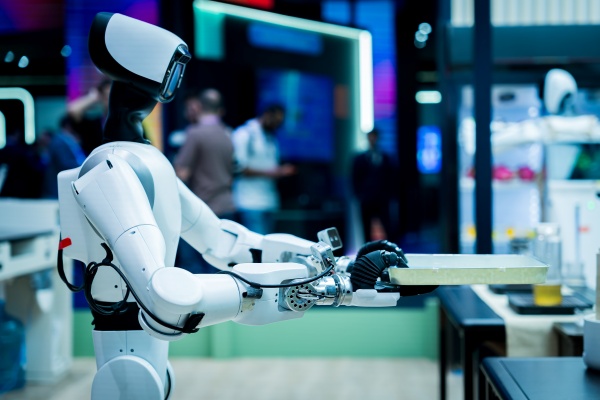
China is stepping up preparations to deploy humanoid robots in the labour market, centred on government-backed training centres. The strategy aims to develop them as an industrial workforce for factories and service sites, beyond simple demonstrations or entertainment.
On May 21 local time, CNBC reported that at a Beijing humanoid robot data training centre, robots are preparing for real-world deployment by repeatedly learning tasks such as factory work, housework, shelf organisation in stores and metal repairs.
The facility is a training centre backed by the Beijing city government. It is part of a humanoid robot training network being built across China. China is fostering humanoid robots as a next-generation strategic industry after electric vehicles and artificial intelligence, with the goal of securing leadership in the global market and supply chains by 2030.
At the site, instructors repeatedly train robot movements using cameras, motion-capture equipment and remote-control devices. Kenneth Ren (케네스 렌) of RealMan Intelligent Technology said, "We are essentially teaching robots to think for themselves."
The key is data accumulation, not simple reproduction of movements. When instructors directly control robot movements, the data generated in the process is used as AI training material. Instructor Fudi Luo (푸디 뤄) explained, "In the beginning, robots have no perception, so manual operation is necessary, but once repeated data builds up, they can later perform tasks on their own."
The range of tasks robots are learning is also expanding quickly. It includes not only sorting work on factory production lines but also housework, massages, organising store shelves and metal repair work. Site officials said some instructors repeat the same movements for 8 hours a day to generate data.
Robot-hand developer Beijing Inspire-Robots Technology is conducting precision motion training on the same campus using sensors and motion-tracking technology. The company's board secretary Winston Zhou (윈스턴 저우) said, "For a robot hand to learn one new skill, it needs an average of more than 10,000 training repetitions." The robot hands developed so far were reported to have advanced to a level where they can pick up eggs or small objects and lift strings.
China's humanoid strategy is already moving beyond the laboratory stage. Some AI-based robots are being trialled in roles such as restaurant chefs and bartenders, waiters, traffic police and operators of small shops. Still, many robots remain dependent on human assistance, and assessments say more time is needed before fully autonomous work.
China's aggressive expansion strategy is also putting pressure on global competitors. Tesla CEO Elon Musk said at an earnings announcement in January that the company was ahead in hand technology for its humanoid robot Optimus, while naming China as the strongest competitor. He said China is very strong in the speed of manufacturing expansion and production capacity.
Within China, there is an emphasis that humanoid robots are intended to take on jobs people avoid, rather than replace humans. Ren said, "Our goal is to assign work that is dangerous or repetitive and that people do not want," adding, "It is not to replace humans themselves."
The industry is paying attention to the fact that China is building data accumulation, field validation and large-scale manufacturing capacity at the same time, beyond simple technology development. A key point to watch will be how quickly it can move beyond the current level that requires human assistance and translate repeated training data into real productivity and autonomous work capabilities.
 Jinju Hong
hongjj@d-today.co.kr
Jinju Hong
hongjj@d-today.co.kr