
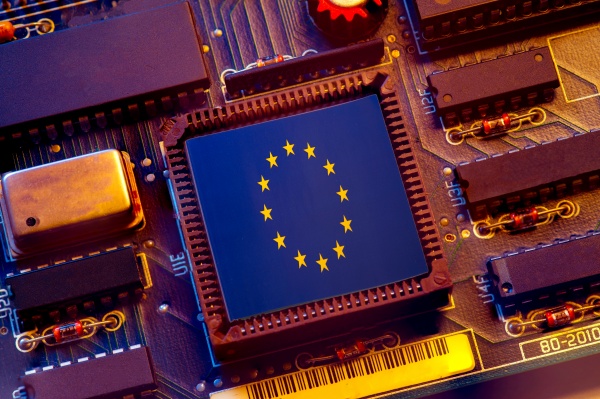
Artificial intelligence infrastructure-related technology shares in European stock markets are surging this year, posting gains from double digits to triple digits.
CNBC reported on May 21 that semiconductor equipment maker Aixtron has risen 189 percent so far this year. Semiconductor process equipment maker Technoprobe is up 129 percent, STMicroelectronics has gained 133 percent and Nokia has risen 108 percent.
The rally has emerged as AI investment, previously centred on the United States and China, expands into infrastructure supply chains such as data centres, networks and semiconductor equipment. Investors are looking for beneficiaries across AI build-out infrastructure, including power, cooling and software tools, not just big foundation-model or cutting-edge chip companies.
Fabio Bassi (파비오 바시), JPMorgan’s head of cross-asset strategy, said scarcity is amplifying gains in Europe. He said Europe does not have many pure AI plays with large liquidity, and money is concentrating in a small number of “AI proxy beneficiaries”. In Europe, buying is clustering in companies where demand directly linked to AI is confirmed.
Aixtron, which has posted the steepest rise, is a German company that makes deposition tools that apply ultra-thin material layers to silicon wafers. Its shares have risen more than 300 percent over the past 12 months. Citi raised its target price by more than 66 percent in an April report, citing strengthening demand and margins, and flagged AI as a key revenue driver in its 2026 guidance.
STMicroelectronics is also cited as a beneficiary of the expansion of AI infrastructure. Brian Colello (브라이언 콜렐로), a senior equity analyst at Morningstar, said semiconductor consumption of all kinds is rising as AI facilities expand, which is positive for STMicroelectronics and peers. He said STMicroelectronics is exposed to AI demand through power semiconductors used in 800-volt power conversion and optical products for high-speed data centre connections.
Nokia is shifting its focus from a mobile phone maker to a hardware supplier for AI infrastructure. Nokia supplies networking and optical communications equipment for AI data centres. It became one of the world’s biggest optical network equipment makers after completing its acquisition of Infinera early last year, and its shares jumped 22 percent at the time after Nvidia said in October last year it would buy $1 billion worth of Nokia shares.
Italy’s Technoprobe makes probe cards used to test silicon wafers. Bank of America upgraded the stock to buy in May, expecting earnings growth linked to demand for graphics processing units (GPUs).
Sector index moves also support the strength in individual shares. The STOXX Europe Total Market Semiconductors index is up 84 percent this year, far outpacing the STOXX 600, which has risen 3 percent over the same period.
The market, however, did not view the rise as a signal of a full-scale rebound across Europe’s AI industry. Martin Shumsky (마틴 슘스키), a Morningstar equity analyst, said interest in supporting AI infrastructure is growing in Europe and Nokia could play a role, but it is likely to proceed under a regulatory regime fundamentally different from that of the United States. He pointed to grid constraints, measures halting data centre construction and the burden of complying with the European Union’s AI Act as obstacles to expanding AI infrastructure in Europe.
Shumsky also said there are not many places that can find sites of more than 500 acres with sufficient power and water, unlike in the United States. For now, the winners in AI deals are still companies that sell products into the U.S. market.
Some expect that beyond infrastructure suppliers, companies that actually adopt AI could also come into the circle of beneficiaries. Colello said software, fintech, healthcare and robotics companies could be the next group of beneficiaries, and said local winners by region could emerge as countries seek to adopt AI in their own languages.
Bassi said the recent surge in some European stocks should not be interpreted as a “broad European tech renaissance”. He said the current trend is closer to a “narrow transmission channel”, with money flowing into a small number of European firms that have real exposure to data centre expansion and can translate that demand into profits.
 Jinju Hong
hongjj@d-today.co.kr
Jinju Hong
hongjj@d-today.co.kr