
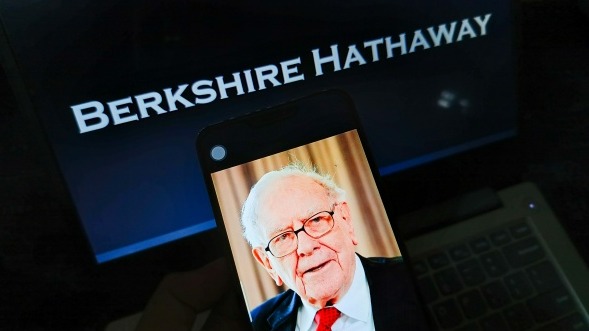
Berkshire Hathaway has disposed of its entire stakes in Visa and Mastercard. Markets are watching whether the decision signals portfolio restructuring beyond a simple call on individual stocks.
On May 21 local time, blockchain media outlet Cryptopolitan reported that Berkshire Hathaway disclosed in its latest quarterly report that it had fully exited some holdings including Visa, Mastercard and Amazon. Investors reviewed the report to check new purchases and weighting adjustments, with attention focused on the full sales of Visa and Mastercard.
The sales are being interpreted as the first large reshuffling move since a Greg Abel-led system, under which Abel is effectively driving portfolio management in place of Warren Buffett. Some analysis also says it could be a process of removing an individual management style, as the stocks overlap with assets previously managed by Todd Combs, who moved to JPMorgan at the end of 2025.
The Wall Street Journal has previously reported that Abel had begun gradually clearing out a group of stocks Combs bought. As a result, the interpretation is gaining ground that the Visa and Mastercard sales were an extension of operational changes rather than a worsening industry outlook.
Visa’s recent business indicators were not bad. Christopher Suh (크리스토퍼 서), Visa’s chief financial officer, assessed the latest quarter as one of the strongest growth periods over the past decade, excluding the rebound period after the COVID-19 pandemic. Value-added services revenue was $3.3 billion, about 30 percent of the total, up 27 percent from a year earlier. Commercial payments and remittance businesses also grew 24 percent, extending overall growth.
Cross-border payments also appeared to remain relatively stable despite the Middle East conflict and the impact of Ramadan. Visa explained that transaction activity improved through mid-May and that card spending showed healthy growth across income levels. On performance alone, it is clear that Berkshire did not sell to dump loss-making holdings.
Visa was the 13th-largest holding in Berkshire’s portfolio and Mastercard the 15th. As of the end of 2025, Berkshire was known to hold about $2.91 billion in Visa and about $2.28 billion in Mastercard.
Visa had been a long-term holding that recorded a cumulative return of more than 1,750 percent, including dividend reinvestment, since it was first added in 2011. That has led to an assessment that the sale is hard to see as a simple effort to avoid losses or respond to deteriorating performance.
Still, the market is pointing to possible structural changes surrounding the card network industry as a variable. If stablecoins and artificial intelligence-based payment systems spread, existing card fee structures could come under pressure. There is also a view that transactions bypassing existing card networks could increase if blockchain-based payment networks expand.
Visa and Mastercard are also responding to such changes. Visa is pursuing a strategy to expand tokenised payments, and more than half of its e-commerce payments are said to be processed on a token basis. That is up about 30 percent from a year earlier and is interpreted as an indicator reflecting the shift in digital payments infrastructure.
The quarterly report also showed new additions and increased stakes, as well as sales. Berkshire increased its stake in Alphabet, which rose into the top ranks of its holdings, while its stake in Chevron was partially reduced.
Market attention is focused on whether Abel will continue to unwind the portfolio from the Combs era, or press ahead with restructuring that also includes stocks with solid fundamentals like card companies.
 Jinju Hong
hongjj@d-today.co.kr
Jinju Hong
hongjj@d-today.co.kr