
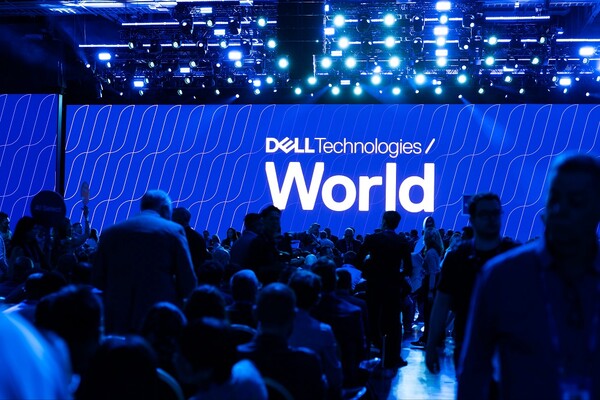
[Las Vegas, United States=Digital Today reporter Jin-ho Lee] Dell Technologies presented a corporate artificial intelligence (AI) infrastructure strategy at this year’s Dell Technologies World (DTW) aimed at preparing for the “tokenomics” era. With agentic AI spreading and driving sharp increases in token usage and data processing volumes, it said companies need full-stack infrastructure spanning computing, networking, storage and security to run AI workloads stably.
DTW 2026, held in Las Vegas from May 18 to 21 local time, has ended. Dell used the event to cement its identity as a full-stack infrastructure company that supports AI workloads. It judged that managing compute demand, data processing volume and cost burdens has emerged as a key task for companies.
◆In an era of surging tokens, emphasis on full-stack infrastructure
Jeff Clarke (제프 클라크), Dell Technologies vice chairman and chief operating officer, presented tokenomics as a keyword for the AI era at the event. Tokenomics is a compound of “token,” a unit of data processed by AI, and “economics.” The term stems from a phenomenon in which token consumption, which has surged with the spread of agentic AI, has emerged as a key variable for corporate management.
In his keynote speech, Clarke pointed to the possibility that the cost structure of using AI could unfold similarly to trends previously seen in the storage and computing markets. As unit costs fall, usage rises and overall spending can increase, he said. “When the unit price of a service or device goes down, new usage increases,” he said. “We have seen this pattern in storage and computing for decades,” he said.
Dell presented infrastructure deployment tailored to workload characteristics as a solution. Rather than handling all AI tasks with a single high-performance model or a single infrastructure, it said companies should use local workstations, on-premises data centres, edge and cloud depending on the purpose.
Tokenomics was also a topic at a media briefing. Clarke referred to the concept of “token routing” and said it is becoming important to distribute AI tasks across PCs, data centres and cloud. Arthur Lewis (아서 루이스), president of the Infrastructure Solutions Group (ISG), also said companies need to manage both the cost of token generation and usage efficiency.
◆Surprise appearance by Jensen Huang highlights Nvidia alliance on ‘AI Factory’
As corporate use of AI spreads beyond the experimental stage into the broader work environment, Dell is betting on its “AI Factory” solution. Dell AI Factory is a portfolio designed to help companies build and scale AI by combining computing, networking, storage, software and services.
Michael Dell (마이클 델), Dell chairman and chief executive officer, presented the Dell AI Factory, developed in cooperation with Nvidia, as a core strategy to prepare for the future AI era in his keynote speech. He outlined a plan to support companies in building and scaling AI while controlling security, governance and cost efficiency by combining computing, networking, storage, software and services.
Jensen Huang’s surprise appearance also remained a symbolic moment. When Huang took the keynote stage together with Michael Dell, loud cheers erupted from the audience. Michael Dell introduced him as “a great partner and friend, a true leader and visionary in the AI era.”
Huang stressed that generative AI is evolving into agentic AI. “Generative AI can not only create content but also lead to reasoning and planning,” he said. “Now, for the first time, we have truly useful AI,” he said.
Huang then said, “As the era of agentic AI arrives in earnest, corporate AI adoption is entering a phase of explosive growth.” “Dell and Nvidia are jointly building a scalable full-stack AI factory from desktops to data centres,” he said.
◆Modernising data centres with distributed private cloud
Dell is also focusing on modernising data centres for the AI era. The “Dell PowerStore Elite,” unveiled at the event, is a next-generation enterprise storage product aimed at this trend. By combining AI-based software, next-generation hardware and non-disruptive modernisation features, it allows companies to secure the performance and capacity needed for AI workloads without fully replacing existing data centres. In security, it is also reinforcing cyber resilience through “Dell PowerProtect One.” PowerProtect One is a platform that protects critical data, detects threats and supports rapid recovery.
In its private cloud strategy, it emphasised “distributed infrastructure.” Dell sees AI workloads spreading beyond public cloud to corporate data centres, edge and desktops. The approach is to run AI closer to where the data is, reducing the burden of data movement and token costs.
Varun Chhabra (바룬 차브라), a senior vice president, said data location and token costs will be important variables in future AI infrastructure strategies. As more agents run, more tokens are used. He suggested companies adopt its private infrastructure solutions to secure a kind of token generator.
Caitlin Gordon (케이틀린 고든), a vice president, also said most corporate data still remains inside company data centres even amid the large flow of AI adoption. “I believe the best option for customers in the future will be distributed infrastructure,” she said.
Through this year’s DTW, Dell clarified its direction as a full-stack provider supporting corporate infrastructure shifts in the AI era. As token usage and data processing volumes rise, Dell is accelerating support for corporate AI business by putting forward next-generation infrastructure such as an Nvidia partnership-based AI factory and distributed public cloud.
Michael Dell said, “The agent era has already begun.” “Dell has differentiated capabilities and a broad portfolio to support it,” he said.
 Jin-ho Lee
jhlee26@d-today.co.kr
Jin-ho Lee
jhlee26@d-today.co.kr