
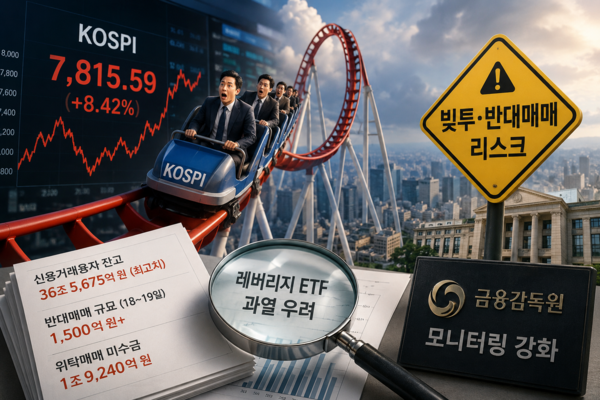
The KOSPI has continued a roller-coaster run, repeatedly plunging and rebounding after breaking above the 8,000 level. The index has been swinging sharply within a day depending on foreign selling and variables including U.S. interest rates and oil prices. With margin loan balances and forced selling rising, financial authorities have moved to curb overheating in leveraged investing.
On May 21, the KOSPI rose 8.42 percent from the previous session to 7,815.59. The KOSDAQ also gained 4.73 percent to 1,105.97. Shortly after the open, both indexes rebounded more than 5 percent, triggering a buy-side circuit breaker.
The rebound was seen as driven by easing domestic and external variables at the same time. International oil prices fell as expectations grew for U.S.-Iran negotiations, and U.S. Treasury yields, which had surged recently, also showed a stabilising trend. Strong Nvidia earnings also affected the recovery in investor sentiment toward domestic semiconductor shares.
News of a tentative labour-management agreement at Samsung Electronics also supported the rebound in semiconductor stocks. Samsung Electronics management and the union reached a tentative deal on the eve of a general strike late the previous night. However, it is hard to conclude it is a final agreement as a union vote remains.
The KOSPI recently underwent a sharp correction after rising above 8,000. But it recouped a significant part of its recent decline with a rebound of more than 8 percent on the day. The KOSPI's daily gain was analysed as the fifth largest since 2000.
Volatility indicators are also high. According to the industry, the KOSPI Volatility Index (VKOSPI), which had a past average of 18.8 points, rose to an average of 50.3 points this year. It stood at 65.5 points on May 21. Regardless of the index direction, the level of risk investors feel has risen sharply.
The problem is that with volatility rising, the burden of leveraged investing by retail investors is also increasing.
According to the Korea Financial Investment Association, margin loan balances hit a record high of 36.6 trillion won on May 15, when the KOSPI touched 8,000 intraday. Forced selling also expanded after the KOSPI slid as low as 7,053.84 intraday on May 20 and plunged 11.83 percent.
The actual amount of forced selling compared with brokerage purchase shortfalls stood at 91.7 billion won on May 18. That was the largest since 92.8 billion won on July 3, 2023.
Forced selling also reached 67.7 billion won on May 19, with more than 150 billion won worth of stocks liquidated over two days. As of May 19, brokerage purchase shortfalls also stood at 1.92 trillion won, nearing 2 trillion won.
Foreign flows remain a burden. Foreign investors posted net sales for 11 straight sessions, matching this year's longest net-selling streak. If foreign selling continues, the upside for the index could be limited and downside pressure could grow.
Conversely, if foreign selling slows, the KOSPI, which has fallen sharply from its high, could also show a strong rebound as it reflects favourable factors.
Money on the sidelines is also increasing. According to the Korea Financial Investment Association, money market fund assets under management stood at a record 262.0 trillion won as of May 19.
They have risen by 10.3 trillion won this month alone. With the KOSPI swinging sharply over a short period, some investors were seen as reducing their exposure to risk assets and moving to short-term standby funds.
Still, the securities industry has also voiced the view that it is difficult to say the uptrend has been completely broken. Ji-young Han (한지영), a researcher at Kiwoom Securities, said the domestic stock market is exposed to volatility but the focus should be on the fact that it is in an earnings-driven market where profit growth outpaces stock price gains.
Financial authorities are wary of an excessive spread of leveraged investing. The Financial Supervisory Service was reported to have urged asset managers, through the Korea Financial Investment Association, to refrain from marketing ahead of the launch of single-stock 2x leveraged ETFs based on Samsung Electronics and SK Hynix.
Single-stock leveraged ETFs are structured to track twice the return of their underlying assets. With high-profile stocks such as Samsung Electronics and SK Hynix used as the underlying assets, losses could also grow if share prices plunge.
Chan-jin Lee (이찬진), head of the Financial Supervisory Service, earlier said at the second Consumer Risk Response Council that a high level of vigilance is needed in a situation where stock market volatility persists, including against financial firms' actions that encourage excessive debt-funded investing and leveraged investing and some finfluencers' actions that disrupt the capital market.
The head of the Financial Services Commission, Eok-won Lee (이억원), also drew a line on expanding single-stock leveraged products. Lee said at a press briefing at the Government Complex Seoul that the underlying assets were carefully selected to prevent a 'wag the dog' phenomenon that reversely distorts the underlying assets, and that authorities would continue to monitor market effects.
Han said, "Right now, we are experiencing aftereffects of speeding following the surge, and macro uncertainty is increasing intraday volatility," but added, "It is hard to say the rally's momentum has been exhausted, as various indicators are improving together and the money move into the stock market is continuing."
 Sangyeop Oh
yub@d-today.co.kr
Sangyeop Oh
yub@d-today.co.kr