
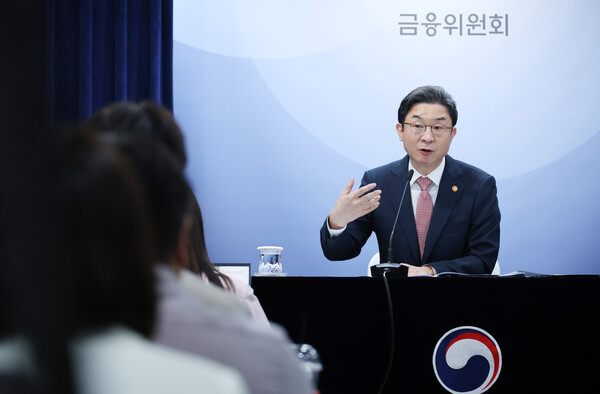
South Korea's Financial Services Commission will expand products eligible for foreign omnibus accounts from stocks to exchange-traded funds and exchange-traded notes. The measure aims to improve overseas retail investors' access to the Korean market and encourage foreign inflows into the domestic capital market.
FSC Chairman Lee Bok-hyun (이억원) said at a news conference at the Government Complex Seoul on the 21st that the commission will expand the scope of foreign omnibus account trading from stocks to ETFs and ETNs.
Foreign omnibus accounts are a system that allows overseas retail investors to trade South Korean stocks through local securities firms without opening separate accounts at domestic brokerages. It reduces procedural burdens such as account opening for overseas investors investing in the South Korean stock market.
Lee said overseas retail investors are sending requests because they want to buy South Korean stocks, but institutional arrangements to accommodate them are not properly in place. He explained the need to improve the system.
The FSC said trading value through foreign omnibus accounts totalled 5.8 trillion won from April 26 to May 15, with net buying of 2.2 trillion won.
Financial authorities will soon give notice of changes to related rules. Lee said if it takes time, they will implement it quickly at ready places through a no-action letter.
Detailed guideline rules related to a ban on duplicate listings are due to be released in late May or early June. Lee said rather than setting explicit exceptions such as allowing duplicate listings in future advanced industries, authorities are considering universal procedures and standards such as specifying directors' duty to protect shareholders and setting criteria for judging whether shareholder protection efforts are sufficient.
Lee took a cautious stance on the possibility of expanding single-stock leveraged products set for launch on the 27th. He said the move is to align regulation with global consistency, adding that underlying assets were carefully selected and products were structured to prevent a so-called "wag the dog" phenomenon in which the product reversely distorts the underlying asset, and that authorities will continue to monitor market effects.
The FSC will also hold "Korea Premium Week" for one month in September. It plans to grow it into South Korea's flagship capital market event.
Rules requiring network separation for security purposes at financial companies will also be eased. The FSC plans from June to temporarily ease network separation rules, following expert review, when financial companies with security capabilities seek to use artificial intelligence to strengthen security.
Lee said limitations of network separation rules are emerging in the era of AI transformation. He said authorities will also consider a plan to fully abolish network separation rules by strictly selecting financial companies with advanced security capabilities and AI utilisation capabilities.
He also mentioned the possibility of easing so-called "separation of finance and commerce" rules that restrict traditional financial firms' participation in digital asset markets. Lee said regarding Hana Bank's equity investment in Dunamu that separation-of-finance-and-commerce rules should consider global market changes as well as user protection and financial stability when financial institutions participate in digital assets, and that authorities will review the issue comprehensively in conjunction with legislation on the second phase of the Digital Asset Act.
 Oh Sang-yup
yub@d-today.co.kr
Oh Sang-yup
yub@d-today.co.kr