
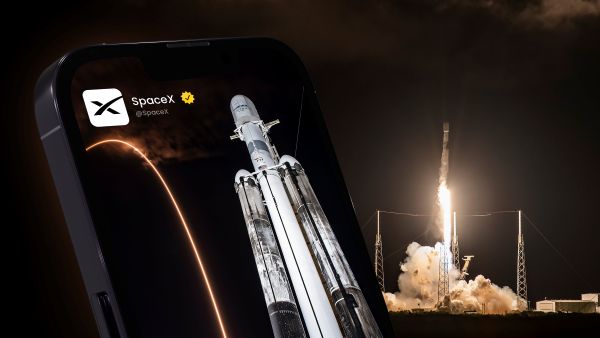
SpaceX has set a goal of pursuing 10,000 rocket launches a year within the next five years. That far exceeds the current number of annual launches worldwide and is seen as a plan that could change the structure of the space launch industry itself if realised.
Cryptopolitan, a blockchain media outlet, reported on May 21 that SpaceX President Gwynne Shotwell (그윈 쇼트웰) recently explained the target of 10,000 launches a year to U.S. Federal Aviation Administration Administrator Brian Bedford (브라이언 베드퍼드). Bedford said the bottleneck at present is not within SpaceX itself.
The target aligns with a forecast Elon Musk mentioned in March on X, formerly Twitter, that launches would take place once an hour within 4 to 5 years. One launch per hour amounts to about 8,760 a year, and SpaceX's proposed 10,000 a year is larger than that.
The gap is overwhelming compared with current launch performance. SpaceX is currently conducting about 160 orbital missions a year. It launched 154 times in 2025, and in 2026 it reached 50 launches by the end of April. Given that worldwide launches last year totalled about 250, SpaceX's target is about 60 times its current pace and about 40 times the annual global total.
The issue is not something that can be solved simply with rocket production capacity. The FAA currently approves a combined total of about 195 SpaceX launches a year across four operating bases. The annual cap at Starbase, Texas was recently expanded to 25 from 5, and Launch Complex 39A at Kennedy Space Center was authorised for 44 Starship launches a year. Two new Starship launch pads at Cape Canaveral Space Force Station can handle 76 a year, and the launch authorisation for Falcon 9 at Vandenberg in California was recently increased to 50 from 36.
As a result, some point out that meeting the goal of 10,000 launches a year would require changes to the United States' existing licensing system for space launches itself. The industry has also raised calls to shift away from the current approach of receiving approval for each individual launch and move to a constant operating system similar to airline operating licences.
A key variable is whether Starship can establish a fully reusable system. Falcon 9 currently launches about once every 2 to 3 days, and that is seen as the world's top record for sustained operations. But to reach 10,000 launches a year, Starship must become a structure capable of repeated reflights within a short time.
The development process has not been smooth. In the two most recent Starship test flights, the vehicle broke up during flight, and the schedule for the next-generation V3 model is also being delayed. The next test flight is to include an upgraded Super Heavy booster and Starship, deployment of a Starlink satellite simulator, and an attempt to land the booster at sea.
There is also a gap with regulators' outlook. The FAA expects the number of launches and reentries in the United States to increase by about 1,000 over the next 4 to 5 years, but SpaceX's target is 10 times higher than that.
As a result, SpaceX's plan for 10,000 launches a year is seen as a large project that requires not only rocket technology but also reusable technology, airspace operations, supply chain expansion and regulatory reform at the same time. The industry views future Starship test flight results and FAA regulatory changes as key turning points for making the target a reality.
 Jinju Hong
hongjj@d-today.co.kr
Jinju Hong
hongjj@d-today.co.kr