
[Las Vegas, United States=DigitalToday reporter Jin-ho Lee] As adoption of artificial intelligence (AI) accelerates, corporate data centre strategies are also changing. Dell Technologies expects AI workloads to spread beyond public cloud to corporate data centres, the edge and desktops. It said infrastructure that runs AI close to data and reduces token costs and the burden of moving data will be key.
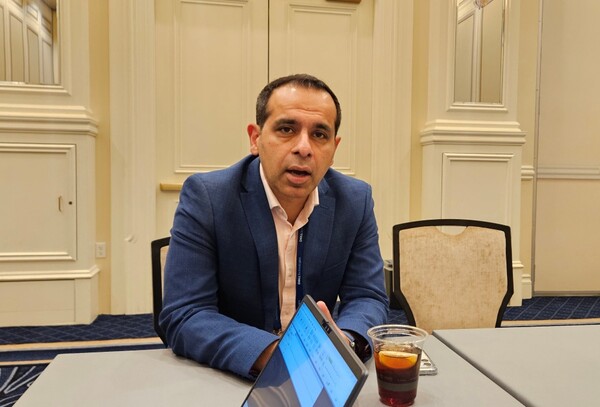
Varun Chhabra (바룬 차브라), senior vice president at Dell Technologies, met South Korean reporters on May 20 local time at Dell Technologies World (DTW) 2026 in Las Vegas. He stressed that data location and token costs will be important variables in future AI infrastructure strategies.
◆ In the AI era, token costs become a variable in infrastructure strategy
Chhabra said the spread of agentic AI could increase demand for on-premises AI. He said private models that shorten data movement paths could also reduce token costs.
Chhabra said, "The more agents run, the more tokens they use." He said most application programming interfaces offered by public clouds or AI providers charge per token, and cases are emerging of users quickly reaching limits.
He added, "Buying deskside equipment or servers is like securing a token generator." He stressed that running AI on-premises or at the desk side can deliver better economics because users do not have to keep paying per-token costs.
Dell is expanding its AI Factory portfolio in cooperation with Nvidia. At this DTW, it announced "Dell Deskside Agentic AI," which can build and operate autonomous AI agents in a local environment. It is a solution that lets companies run autonomous AI agents securely without taking data outside. It can also shift volatile cloud token costs into predictable infrastructure investment.
Chhabra also stressed on-premises use of frontier models. He said, "In the past, models such as Gemini, Grok and OpenAI could only be used in the cloud." He explained, "Now we are supporting their use in on-premises environments based on Dell servers."
◆ "A distributed private cloud is the next-generation option"
Dell is putting forward "distribution" as its private cloud strategy. Caitlin Gordon (케이틀린 고든), a vice president, presented a distributed private cloud as a next-generation cloud architecture.
Gordon said, "Even amid the huge wave of AI adoption, most enterprise data is still inside corporate data centres." She said, "I believe the best option for customers going forward will be distributed infrastructure."
Dell Private Cloud (DPC) combines the operational simplicity of existing hyperconverged infrastructure (HCI) with the efficiency, scalability of traditional three-tier architecture. It can independently scale computing, storage, networking and the virtualisation layer, allowing companies to flexibly increase only the resources they need.
Dell also expects significant cost advantages. In an HCI structure, compute nodes must handle both application workloads and storage workloads, requiring large amounts of memory and drives. In a distributed cloud, compute can focus on application workloads, reducing the number of nodes, the number of cores and hypervisor licence costs. Gordon said the distributed infrastructure approach can be up to 65 percent more cost-efficient than HCI.
It is also a strategy aimed at companies reviewing hypervisor strategies after Broadcom's acquisition of VMware. Gordon said, "DPC was created to support customers seeking an exit from VMware." She said it provides a cost-efficient foundation that supports current hypervisors while allowing a shift in a different direction later.
 Jin-ho Lee
jhlee26@d-today.co.kr
Jin-ho Lee
jhlee26@d-today.co.kr