
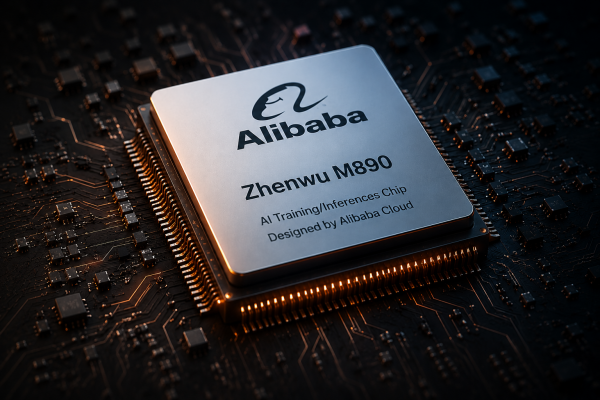
Alibaba has unveiled its new artificial intelligence (AI) chip, the Zhenwu M890, accelerating competition in China to replace Nvidia chips. With U.S. semiconductor restrictions on China continuing, a push by Chinese big tech companies to build their own AI infrastructure is becoming more pronounced.
On May 20, major foreign media outlets including Cryptopolitan reported that Alibaba unveiled a new AI chip, a server system and a large language model (LLM) at an "Alibaba Cloud Summit" held that day.
The Zhenwu M890 announced this time was designed with a performance target of up to three times faster than the previous generation. Alibaba explained that the chip was developed for AI agents that carry out complex tasks through multiple steps. It said it strengthened memory and communications performance needed for large-scale data processing, and was designed to support simultaneous collaboration across multiple systems.
Alibaba also unveiled a roadmap for follow-on products. It aims to launch the next-generation chip "V900" in the third quarter of 2027 and "J900" in the third quarter of 2028. It also introduced the "Panju AL128" server system, which houses 128 AI accelerators in a single rack. Chinese corporate customers can use the system through Alibaba Cloud's "Bailian" platform.
It also presented semiconductor supply results. Alibaba-affiliated chip company T-Head said it has supplied more than 560,000 Zhenwu chips to more than 400 customers to date. The customer base includes companies in 20 industries such as automakers and financial institutions.
Alibaba also unveiled its new LLM, "Qwen 3.7-Max". The company said the model was optimized for advanced programming and long-duration AI agent work, and designed to maintain performance continuously for up to 35 hours.
In the market, an interpretation is emerging that the announcement goes beyond a simple chip unveiling and is a strategy to build an in-house ecosystem integrating semiconductors, cloud and AI models.
Alibaba's move coincides with a time when restrictions on distributing Nvidia chips in China are being tightened. The Financial Times (FT) reported that a sales restriction on Nvidia's China-market graphics card "RTX 5090D V2" has recently taken effect.
According to the report, Chinese motherboard manufacturers were notified by customs that the product would not receive customs clearance approval. Distributors are also reported to be having difficulty securing sales permits.
In particular, attention is also focused on the point that the restriction is a Chinese measure, not one by the U.S. government. The United States is allowing some Chinese companies to place orders for Nvidia's H200 AI chip on a limited basis, but in China a separate move toward controls is appearing, according to analysis.
Nvidia launched the RTX 5090D as a China-only product to bypass U.S. regulations and has newly released the "RTX 5090D V2" with reduced memory. The industry is also observing that some companies are using the product by unofficially expanding its memory.
Distribution confusion in China is also continuing. JD.com recently sold some Nvidia products, including the RTX 5090D V2, through a dedicated "AI GPU" page, but took down the page after related reports. As official distribution is blocked for products designed for China, the possibility of them flowing into unofficial sales channels is also being discussed.
China's gaming market is also being affected. For gamers, the RTX 5080 has effectively remained the top-end alternative, and prices of Nvidia and AMD products continue to rise. Chinese domestic chipmakers are still not at the level of Nvidia's latest chips.
Meanwhile, Nvidia is also facing criticism over AI graphics technology. Some developers and users have reacted to its recently unveiled AI-based graphics system by saying, "It has less character than the original" and "Character 표현 is unnatural."
As access to Nvidia products in the Chinese market is being constrained in this way, Alibaba made clear its direction to absorb corporate demand with a strategy combining its in-house AI chip, cloud infrastructure and AI models.
 Jinju Hong
hongjj@d-today.co.kr
Jinju Hong
hongjj@d-today.co.kr