
[DigitalToday reporter Jinju Hong (홍진주)] Tesla has again downgraded the published acceleration specifications for its new Model 3 Premium rear-wheel-drive car sold in Canada. As the specifications have repeatedly changed since launch, a consumer trust dispute is growing.
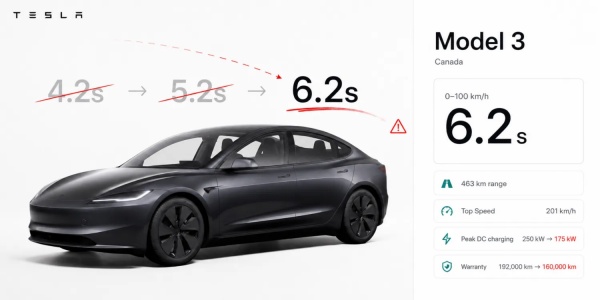
Electrek, an electric-vehicle outlet, reported on Tuesday that Tesla recently revised the car’s 0 to 100 km/h time to 6.2 seconds from 5.2 seconds.
The model first launched in the Canadian market on May 1. At the time, Tesla set the price at C$39,490 and disclosed specifications including a 463 km driving range per charge, a 0 to 100 km/h time of 4.2 seconds and a maximum fast-charging speed of 250 kW. The price drew attention as among the cheapest Model 3 vehicles sold in Canada.
But within 48 hours of the launch, Tesla revised the acceleration figure to 5.2 seconds and explained that the earlier 4.2-second figure was a “website error”. In the process, the maximum fast-charging speed was also lowered to 175 kW from 250 kW, and battery warranty terms were cut to 160,000 km from 192,000 km. About 2 weeks later, Tesla revised the acceleration figure again to 6.2 seconds.
The currently published 6.2-second figure matches the specification for the Shanghai-produced Model 3 Standard rear-wheel-drive version sold in other markets including Europe. The industry is putting weight on the possibility that the 4.2-second figure presented at launch did not match actual performance from the start.
The Canada-spec Model 3 Premium rear-wheel-drive uses a different rear motor from previous models sold in Canada. The new car applies a '3D7' motor with maximum output of 194 kW and maximum torque of 340 Nm. The '3D6' motor used in the earlier model had maximum output of 220 kW and maximum torque of 440 Nm. As a result, output fell by 26 kW and torque by 100 Nm.
The battery configuration is also being cited as a reason for the performance change. This model is equipped with an LFP (lithium iron phosphate) battery. LFP cells are generally seen as having lower instantaneous discharge performance than NMC batteries, which can be a disadvantage in initial acceleration. On the other hand, they are seen as offering advantages in price competitiveness and durability, raising the possibility that Tesla chose this combination to meet the price level of C$39,490.
The issue is that the specifications have been changed repeatedly. Electrek pointed out that during the first revision it was possible to consider a simple typo or confusion during a production-site transition, but the later change to 6.2 seconds weakened the persuasiveness of the “website error” explanation. The outlet assessed: “If the first figure was simply a mistake, it is questionable why it was not corrected immediately to the accurate number.”
In terms of product competitiveness alone, there is also an assessment that 6.2 seconds is still sufficient for a sedan for everyday driving. Still, analysis says the repeated changes to performance, charging and warranty terms since launch have increased the burden of trust for consumers.
The market sees price competition in electric vehicles intensifying further. Electrek also mentioned that Chinese electric-vehicle maker BYD is pushing to open about 20 dealerships in Canada, and forecast that in future competition, not only price but also the accuracy and transparency of specification information could emerge as an important variable.
 Jinju Hong
hongjj@d-today.co.kr
Jinju Hong
hongjj@d-today.co.kr