
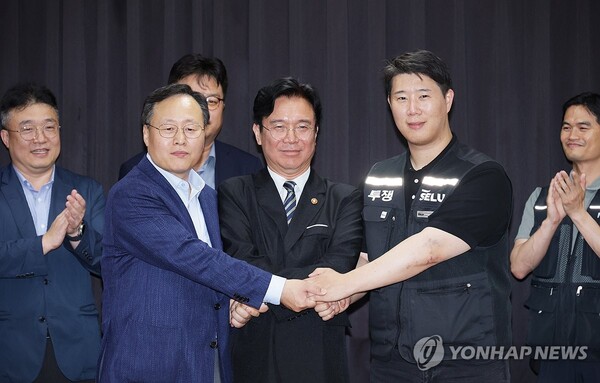
Samsung Electronics management and its labour union signed a tentative agreement on 2026 wage talks at 10:30 p.m. on May 20. An 18-day general strike the union had announced, from May 21 to June 7, is tentatively suspended. A conflict that followed a declaration in March to halt negotiations, an April rally and two failed rounds of post-mediation enters a phase of being patched up on the day the strike was due to be announced. Whether it is finalised depends on the result of a membership vote.
The agreement is reached at a bargaining table arranged again after the second post-mediation attempt fails earlier that day. It comes about 6 hours after wage talks resume at 4:25 p.m. Yeo Myeong-gu, head of the People Team at Samsung Electronics' DS (semiconductor) division, and Choi Seung-ho, chair of the Samsung Electronics chapter of the Samsung Group Inter-Company Labor Union, directly sign the tentative agreement at the Gyeonggi Employment and Labor Office in Suwon, Gyeonggi Province.
The agreement follows the collapse of post-mediation by the National Labor Relations Commission and comes after Minister of Employment and Labor Kim Young-hwan directly mediates and commission chairman Park Su-geun continues a coordinating role to find a last-minute meeting point. Concerns that losses could reach 100 trillion won if a strike materialises, along with pressure from the government to exercise emergency arbitration authority, bring both sides back to the bargaining table.
Concerns that expected losses could reach 100 trillion won if a strike materialises become a decisive driver of the agreement. The union says a strike would cost the company around 30 trillion won in losses, and global investment bank JP Morgan forecasts annual operating profit could fall by more than 40 trillion won. There is also a view that losses could exceed 100 trillion won if production facilities and raw materials such as wafers are damaged. Six major economic groups warn that a strike at Samsung Electronics, which accounts for about 25 percent of the KOSPI market capitalisation, could accelerate a fall in the KOSPI index and an exodus of foreign investors, and they call for the immediate exercise of the government's emergency arbitration authority.
The government also makes an all-out effort to secure an agreement. President Lee Jae-myung (이재명) urges compromise at a cabinet meeting and emergency economic policy meeting, saying, "Efforts to realise interests through the right to collective action are good, but isn't there an appropriate line there as well?" Prime Minister Kim Min-seok (김민석) says in a public address on May 17, "The government will consider all possible response measures, including emergency arbitration, to protect the national economy." An analysis says pressure to exercise emergency arbitration authority brings both sides back to the bargaining table.
The American Chamber of Commerce in Korea also issues an official position saying, "If significant production disruptions occur, there are concerns about supply bottlenecks and increased price volatility in the global memory semiconductor market." Shareholder backlash also speeds up the agreement. Criticism continues that the union's demand to fix and allocate a certain proportion of operating profit as a performance-bonus fund undermines corporate value and infringes shareholder interests.
Kim Young-hwan says, "Without letting go of the thread of dialogue until the end, we reached a tentative agreement through autonomous labour-management bargaining," adding, "That seems to be why Samsung Electronics is called a company of the people."
Choi says at a briefing that day, "Through three rounds of National Labor Relations Commission procedures, we narrowed differences between labour and management and reached a tentative agreement," adding, "At the same time as the tentative agreement was produced, the joint struggle headquarters postponed the general strike." He then bows to the public and says, "I am sorry to have caused concern due to internal conflict." Yeo, a vice president, says, "The principle that 'where there is performance, there is compensation' was upheld," and explains, "Through this tentative agreement, we have substantially specified the institutionalisation of the compensation system, including a special compensation scheme."
A key part of the agreement is the creation of a special management performance bonus for the DS division. The existing excess profit incentive plan, or OPI, is maintained, but a special management performance bonus funded by 10.5 percent of business performance selected through labour-management agreement is to be newly introduced for the DS division. There will be no cap on the payout rate, and the funding allocation is 40 percent to the division and 60 percent to business units. The payout rate for common organisations will be set at 70 percent of the level for the Memory Business. The special management performance bonus will be paid entirely after tax in company shares, and one-third of the shares paid can be sold immediately, while the remaining one-third portions will be restricted from sale for 1 year and 2 years, respectively.
The special management performance bonus will apply for the next 10 years, with conditions attached. The conditions are that DS division operating profit reaches 200 trillion won each year from 2026 to 2028, and 100 trillion won each year from 2029 to 2035. Loss-making business units will receive 60 percent of the common payout rate, starting with the 2027 allocation.
The average wage increase rate this year is set at 6.2 percent, including a base increase of 4.1 percent and a performance increase of 2.1 percent. Childbirth congratulatory payments will be raised to 1 million won for the first child, 2 million won for the second and 5 million won for the third and additional children. The DX division and the CSS business team will receive company shares worth 6 million won as part of cooperation for shared growth.
◆ Vote from May 22 to 27... If approved, this year's agreement is finalised
Samsung Electronics management says in a statement after the agreement, "Reaching an agreement, albeit late, was possible thanks to the support of the public, shareholders and customers, the government's dedicated coordination, and employees who quietly stayed in their places," adding, "We will build mature and constructive labour-management relations so this never happens again."
The union will then hold a vote from 2 p.m. on May 22 to 10 a.m. on May 27. Final confirmation requires participation by a majority of enrolled members and approval by a majority of those voting. If passed, this year's wage agreement will be finalised and the general strike will, in effect, be withdrawn. If rejected, the possibility remains that discussions of a general strike will be reignited.
 Suk Dae-geon
d2dg@d-today.co.kr
Suk Dae-geon
d2dg@d-today.co.kr