
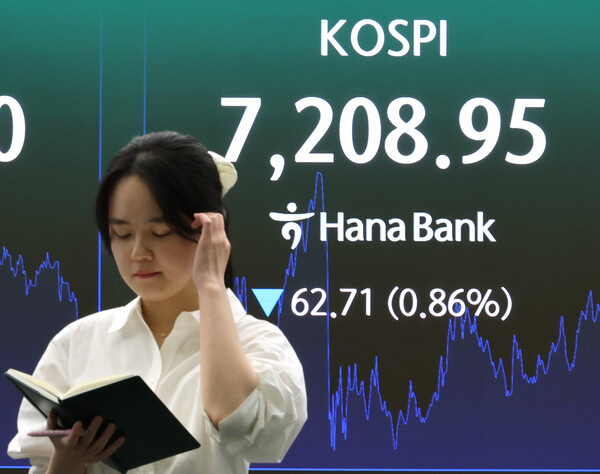
South Korea's KOSPI showed extreme volatility from the open on Tuesday and ended lower around the 7,200 level. Foreign investors again net sold nearly 3 trillion won, but some in the market said it looked more like profit-taking focused on sharply rising semiconductor shares than a full-scale exit.
The KOSPI closed down 62.71 points, or 0.86 percent, at 7,208.95 from the previous session. The index opened up 52.86 points, or 0.73 percent, at 7,324.52, but soon turned lower and at one point slid to 7,053.84, threatening the 7,000 level.
By investor type, individuals and institutions net bought 1.7019 trillion won and 1.1145 trillion won, respectively, while foreigners net sold 2.9294 trillion won.
Top market-cap stocks were mixed. Samsung Electronics rose 0.18 percent to 276,000 won, and SK Hynix ended flat. SK Square, Samsung Electro-Mechanics and HD Hyundai Heavy Industries rose 0.88 percent, 7.50 percent and 6.35 percent, respectively.
Hyundai Motor fell 1.99 percent, LG Energy Solution fell 3.87 percent, Doosan Enerbility fell 4.43 percent and Hanwha Aerospace fell 2.88 percent.
The KOSDAQ also ended down 28.29 points, or 2.61 percent, at 1,056.07.
In the Seoul foreign exchange market, the won-dollar exchange rate fell 1.10 won, or 0.07 percent, to 1,506.70 won.
Some in the market interpreted the heavy foreign net selling on the day as profit-taking in sharply rising semiconductor shares rather than a shift in trend.
Han Ji-young (한지영), a researcher at Kiwoom Securities, said foreign investors' cumulative net selling this year is larger than during the past global financial crisis or during COVID-19, but foreigners' ownership share in the KOSPI has risen instead. She said that is because the pace of share-price gains, led by semiconductors, has outstripped the pace of selling.
Lee Kyung-soo (이경수), a researcher at Hana Securities, also said the current foreign net selling is not about reducing exposure to South Korea but a process of adjusting holdings that are rising too quickly. He said that in broader terms, it can still be seen as moving toward increasing South Korea exposure.
 Oh Sang-yup
yub@d-today.co.kr
Oh Sang-yup
yub@d-today.co.kr