
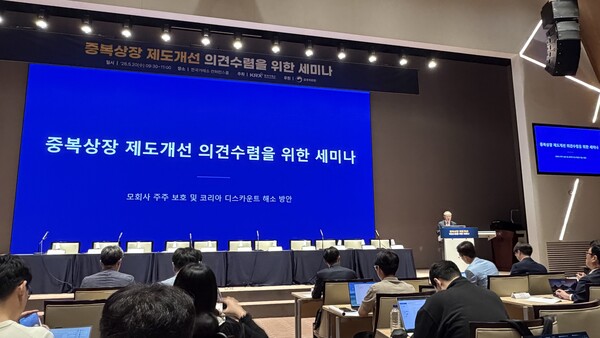
With the government launching work to improve rules on duplicate listings, policy is taking shape around a “principle ban, exceptions allowed” approach. Participants broadly agreed on the need to prevent damage to parent-company shareholders’ interests and ease the Korea discount. Views diverged, however, among market participants, legal circles and the investment industry over how far shareholder approval should be made mandatory.
At a seminar on improving the duplicate listing system held on May 20 at the Korea Exchange building in Yeouido, Seoul, the key issue was how to balance investor protection with corporate fundraising in connection with duplicate listings.
The Financial Services Commission stressed that duplicate listings should be viewed not as a simple issue of transaction structure but as a matter directly tied to confidence in the capital market.
Ko Young-ho (고영호), head of the capital markets division at the FSC, said, “The policy direction is a co-prosperity capital market where investors fairly enjoy the fruits of corporate growth and that in turn leads to reinvestment.” He added, “We judged that moving toward a principle ban on duplicate listings, with exceptions recognised, would help enhance confidence in the capital market.”
The key is protecting parent-company shareholders: “If growth engines leave, market trust will be shaken”
The starting point for the discussion is controversy over listing a subsidiary after a physical spin-off, so-called “split listing”. From investors’ perspective, they invest in the parent, but if core business units or future growth engines are separated into another company and listed, existing shareholders’ interests can be diluted. The FSC sees that if this structure is repeated, investors will find it hard to trust companies and the market.
Nam Gil-nam (남길남), a senior research fellow at the Korea Capital Market Institute, presented two main issues for improving the duplicate listing system in his briefing that day.
The first is whether shareholder approval is needed, and the second is how to obtain it if it is needed. Nam explained that a balance must be found between corporate autonomy and the effectiveness of protecting ordinary shareholders. He suggested several options, including strengthening board obligations, partial mandates based on exchange judgment, and making shareholder approval mandatory in principle.
He also presented the view that, as amendments to the Commercial Act have strengthened directors’ duty of loyalty to shareholders, it could be respected if the board faithfully carries out an impact assessment on shareholder value, prepares protection measures, communicates with shareholders, decides and discloses pro and con views, and follows required procedures.
At the same time, participants pointed out that doubts remain over whether boards of domestic listed companies are in practice independent from controlling shareholders.
"Cause of the Korea discount" vs "Could block corporate fundraising"
On the investor side, there were calls for stronger regulation. Kim Hyung-kyun (김형균), a division head at Cha Partners, pointed out that a duplicate listing structure creates conflicts of interest between parent and subsidiary shareholders and ultimately becomes a discount factor for both the parent and the subsidiary.
Kim said, “The duplicate listing structure of Korean companies is one of the important causes of the Korea discount,” and argued that new duplicate listings should be banned in principle with exceptions allowed.
He explained that listing a subsidiary is not the only way to raise funds, and that alternatives can be considered, such as a split-off or distributing the parent’s stake in the subsidiary to the parent’s shareholders.
By contrast, the IPO and venture capital industry raised concerns that excessive regulation could block companies from raising growth capital.
Kim Kyung-soon (김경순), head of the IPO division at Daishin Securities, said, “If a company is to invest in new industries, raising external funds is essential, but if listings in parent-subsidiary structures are seen only as a problem, there could be negative effects in terms of corporate growth, job creation and enhancing industrial competitiveness.”
He stressed the need for an approach that comprehensively considers subsidiary independence, the impact on the parent and corporate governance, rather than blocking all cases uniformly.
In the private equity industry, there were also voices expressing concern about a shrinking exit route for investments.
Lim Shin-kwon (임신권), chief legal officer at IMM Private Equity, said, “If duplicate listings are banned in principle and the requirements for allowing exceptions are operated strictly, it can function in reality close to a ban given domestic conditions.” He added, “In that case, a side effect could arise where investment itself, needed by the parent company or the national economy, is reduced at the source.”
In academia, there was also analysis that layered listings through affiliate separation are a bigger issue than duplicate listings themselves. Wang Soo-bong (왕수봉), a professor at Ajou University, introduced a Taiwan case and said, “In Korea, the problem is not duplicate listings themselves, but the structure of separating affiliates and creating layered listings.” He added, “The core is the gap between ownership and control, where a controlling shareholder expands control while taking a smaller share of cash-flow rights.”
Special resolutions, 3 percent rule, MOM: shareholder approval methods are also a challenge
How to obtain shareholder approval is also an issue. The briefing reviewed options including special resolutions, a 3 percent voting-rights cap and Majority of Minority, or MOM.
Special resolutions have the advantage of being highly consistent with the existing Commercial Act framework and institutionally stable. But participants said their practical checking effect could be limited in domestic listed companies where controlling shareholders have high ownership stakes.
They said that, with low participation rates by ordinary shareholders at general meetings, a special resolution may not act as a major barrier at companies where a controlling shareholder holds a significant stake.
The Majority of Minority method can exclude the influence of controlling shareholders and most directly reflect the will of ordinary shareholders. However, concerns were also raised that, in practice, the cost and procedural burden of securing voting rights are heavy and that effectively granting minority shareholders a veto could conflict with the current legal framework.
In legal circles, participants viewed the key as not the pro and con procedure itself, but what efforts a company made to minimise dilution for ordinary shareholders and enable them to share in the benefits of a subsidiary listing. They said both the substance of shareholder protection measures and the accountability of the board’s judgment should be considered.
Lim Heung-taek (임흥택), an executive director at the Korea Exchange’s stock market division, said, “We will maintain the basic principle of the need to protect shareholders, but will closely review how to simplify various matters.” He added, “We will consult with financial authorities to prepare draft standards as soon as possible.”
 Oh Sang-yup
yub@d-today.co.kr
Oh Sang-yup
yub@d-today.co.kr