
[DigitalToday reporter Jinju Hong (홍진주)] Android is said to be preparing a new feature called 'Continue On' to strengthen continuity of work across devices.
An online media outlet, Gigazine, reported on May 20 that the feature is an operating system-level function designed to let users seamlessly continue tasks started on one device on another Android device.
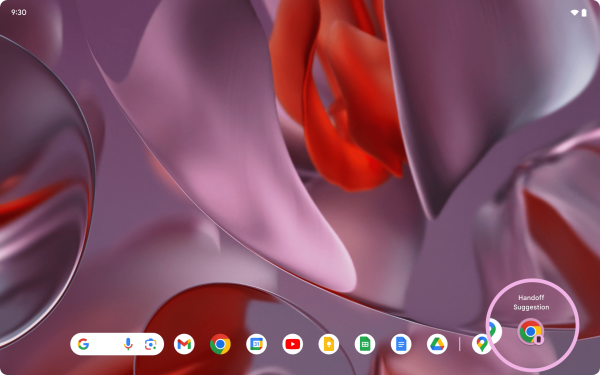
Its initial scope focuses on switching between smartphones and tablets. If a user stops using a specific app on a smartphone, such as for document editing, writing an email or web browsing, the state is passed to another device. On the tablet, the app appears on the taskbar as a 'Handoff Suggestion'. Users can tap it once to resume from where they left off. The key is that it restores the screen state and workflow, rather than simply relaunching the app.
The feature is not limited to specific apps. It can be used not only in Google ecosystem apps such as Google Docs and Gmail, but also in a wide range of third-party apps if developers implement it. To support this, Google plans to provide 'Continue On' at the Android 17 API level and to help developers design how work states are transferred to fit each app’s characteristics. That makes it closer to a structural change affecting the broader app development ecosystem than a simple system feature.
The core aim is to integrate device switching within the Android ecosystem into a single continuous flow. Until now, Android experiences across devices such as smartphones, tablets and Chromebooks have been relatively separated, but Continue On is an attempt to connect them like a single workspace. Users would no longer need to save files or reopen apps to repeat the same work. They would naturally take over tasks the moment they move to another device.
The market is also paying attention to the fact that the feature resembles Apple’s Handoff. Apple already offers continuity between iPhone, iPad and Mac, and Android is seen as moving to implement a similar level of multi-device experience at the operating system level. In particular, Google is focusing not on simple app synchronisation but on sharing the work state itself, raising the likelihood that cross-device competition will intensify further.
Still, what has been revealed so far is limited to an early implementation stage. It will initially support only switching from a smartphone to a tablet, and the pace of adoption is expected to depend heavily on the Android 17 rollout schedule and whether app developers adopt it. Even so, the industry sees the feature as meaningful because it could be an important change that shifts the Android ecosystem’s user experience from being 'device-centric' to 'task-centric'.
 Jinju Hong
hongjj@d-today.co.kr
Jinju Hong
hongjj@d-today.co.kr