
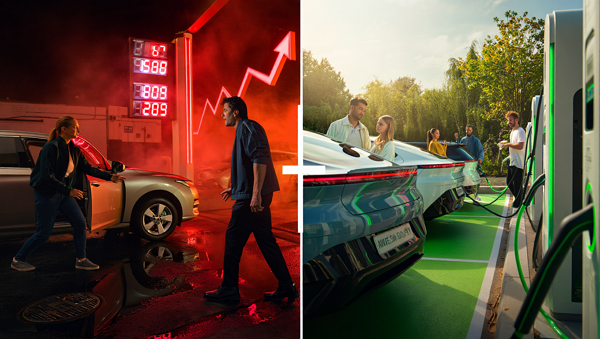
[Digital Today reporter Yoonseo Lee (이윤서)] An analysis says EV charging fees could be much lower than many drivers think.
CleanTechnica, an EV outlet, reported on May 19 that what actually determines EV operating costs is not fast-charging fees but time-of-use household power rates and higher energy efficiency than internal combustion cars.
The first factor to consider is time-of-use electricity pricing. South Korea’s EV charging fees are structured to vary by time band. Under Korea Electric Power’s low-voltage tariff 기준 for non-public slow chargers, the summer off-peak rate is 84.3 won per kilowatt-hour, the mid-load rate is 172.0 won and the peak-load rate is 259.2 won. That means charging during late-night off-peak hours can significantly reduce costs compared with peak hours, even using the same electricity.
The energy efficiency gap between EVs and internal combustion vehicles also widens the difference in operating costs. Gasoline vehicles use only about 12 to 30 percent of fuel energy for actual driving, while EVs use about 77 to 90 percent of the electricity received from the grid for propulsion. That means far less energy is needed to travel the same distance.
For that reason, an analysis says EVs are more favorable in the cost of driving 100 miles, about 161 km, in most cases under the current electricity and gasoline price structure. If power prices are excessively high or gasoline prices are unusually low, gasoline cars could be more economical. Still, it says EVs have an advantage in driving costs under typical pricing conditions.
The analysis also cited a gap between market perception and actual costs. Consumers who have not yet bought an EV tend to think first of using public fast chargers, which can make charging costs look similar to gasoline costs. But most EV drivers do not use fast chargers often, and charging is often done at home or at work.
Some slow-charging stations were also mentioned as a factor that can lower costs. Level 2 chargers installed at restaurants or shopping malls are often cheaper than fast charging, and some are offered for free. It also cited cases of some drivers regularly using nearby free chargers for years.
The analysis also presented differences in perceived costs. It said an EV can drive nearly 200 miles, about 322 km, for the cost of a comparable gasoline vehicle driving 30 miles, about 48 km. That shows EV driving costs could be as low as one-sixth of running a similar internal combustion car. Still, it said the difference does not apply equally to all drivers and can vary depending on local electricity pricing systems and charging habits.
The analysis said this structure shows it is important which 기준 is applied when comparing EV costs. Judging EV economics only by fast-charging unit prices can overestimate actual operating costs. By contrast, considering late-night home charging and high drivetrain efficiency together can make typical EV driving costs lower than consumers expect.
 Yoonseo Lee
yslee@d-today.co.kr
Yoonseo Lee
yslee@d-today.co.kr