
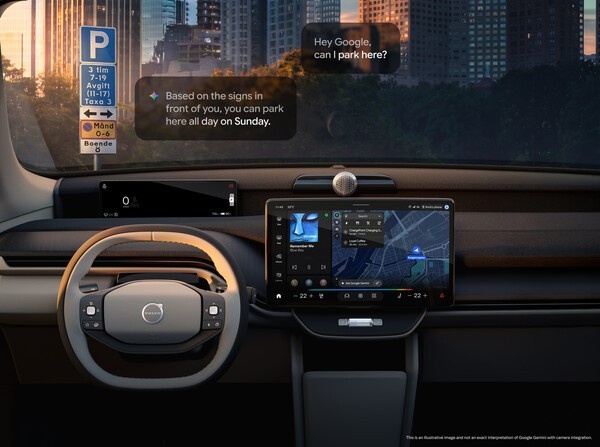
Google and Volvo will introduce Gemini-based artificial intelligence features linked to a vehicle’s external cameras in the next-generation electric sports utility vehicle, the EX60. The car will recognise its surroundings in real time and describe them by voice. Some see the move as expanding in-car AI competition beyond simple voice commands to a stage of understanding what the vehicle sees.
On May 19, local time, IT outlet The Verge reported the two companies unveiled new AI features for the EX60 at Google I/O 2026. The main function is that when a driver asks about what is happening around the vehicle, Gemini interprets the road environment and sign information based on scenes captured by the external cameras.
Volvo currently uses Google’s in-car operating system, Android Automotive. Based on that, Gemini in the EX60 will be able to access external camera information.
The first example Google presented was interpreting complex parking signs. For example, if a driver asks, "Can I park here?", Gemini reads the sign and explains allowed parking hours, whether a permit is required and applicable restrictions.
Google also mentioned the possibility of broadening the scope of the functions. The company envisions developing it to recognise lane markings and road signs, and to answer questions about nearby landmarks, restaurants and buildings.
Patrick Brady (패트릭 브래디), vice president of Google Android Automotive, said, "As Gemini gets better at understanding the environment while driving, it will deliver a more useful driving experience."
The feature is not implemented by the AI model alone. The EX60 will be equipped with a Qualcomm Snapdragon system-on-chip, and will also use an over-the-air software update system. That means high-performance computing resources and update infrastructure are essential to process external camera video in real time and continuously improve the functions.
Still, actual usability is likely to depend on accuracy. While parking-sign interpretation could provide immediate convenience, incorrect judgements could lead to problems such as fines or towing. Google also acknowledges that verifying the feature is important. Another burden is that drivers may disable the function if they do not trust it.
Camera-based AI is also linked to advancing navigation functions. Volvo will be among the companies to get priority access to a new "immersive navigation" feature in Google Maps. The feature provides directions based on 3D graphics similar to real road environments. If combined with vehicle camera information, interactive directions that reflect nearby landmarks, such as "Turn left in front of the library after passing the next traffic light," are expected to become possible.
The industry views the announcement as showing a shift in the direction of competition in in-car AI. If in-car AI has so far focused on voice commands and vehicle control, analysis suggests it is now evolving into a form that understands the surrounding environment in real time and interacts with the driver.
Volvo is strengthening a differentiated user experience by combining vehicle hardware with the Android Automotive ecosystem, and Google is expanding Gemini’s scope beyond smartphones and search services into cars.
 Jinju Hong
hongjj@d-today.co.kr
Jinju Hong
hongjj@d-today.co.kr