
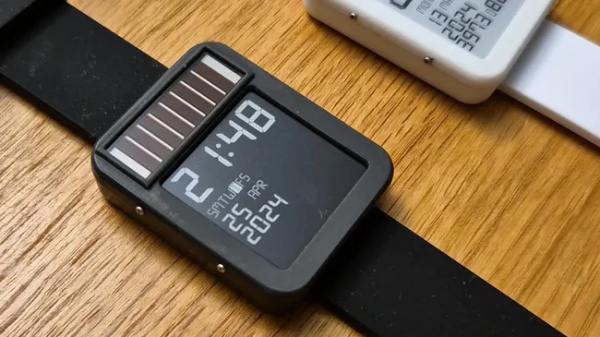
An open-source smartwatch project designed to push battery life to an extreme has emerged. The smartwatch, called LightInk, uses an E-Ink display and a solar charging structure and can be used for up to 400 days on a single charge, it says.
According to IT outlet TechRadar on May 19, LightInk adopts a design focused on maximising battery efficiency rather than high-performance features, unlike typical smartwatches. Its core is an E-Ink display and a solar charging system.
The project’s creator explained it was designed so the watch can continuously top up its battery as long as there is sunlight. The creator highlighted long-term use without connecting to an external power source as a key feature. The creator said that even excluding solar charging, its basic battery life reaches up to 400 days.
Such long use comes from a structure that boldly cuts functions. LightInk uses a black-and-white E-Ink panel instead of the AMOLED display widely used in typical smartwatches. E-Ink is considered a technology with high battery efficiency because it consumes power only when the screen changes.
LightInk introduces itself as an "intentionally basic product". That means it focuses on minimising the burden of charging rather than using flashy screens or a variety of sensors like premium smartwatches.
It also has significant functional limitations. The screen is based on a low-resolution black-and-white display and does not support showing time in seconds. Most health measurement functions and exercise sensors are also excluded. Current functions are limited to showing the time, intermittent WiFi connections and GPS.
How it is bought and used is also far from typical consumer electronics. LightInk is an open-source project that is not sold as a finished product. Users must make parts themselves using a 3D printer and general-purpose components, and complete the device through assembly and soldering.
Users must also build the software themselves. The project has released related materials and firmware information through GitHub, and users can install their own firmware based on it.
Its cost structure is also different from typical smartwatches. The project itself is released as free open source, but building it requires a 3D printer, the cost of buying parts and the ability to assemble it.
In the industry, LightInk is seen as closer to an experimental project aimed at a specific group of users than a mass-market smartwatch. It is not suitable for users who want fitness logging or health monitoring functions, but it is viewed as a differentiated option for users who want a device that can be used for a long time without charging.
As the smartwatch market has recently moved toward performance-driven competition, LightInk is drawing attention for presenting an extreme design direction that prioritises battery life over functions.
 Hong Jin-ju
hongjj@d-today.co.kr
Hong Jin-ju
hongjj@d-today.co.kr