
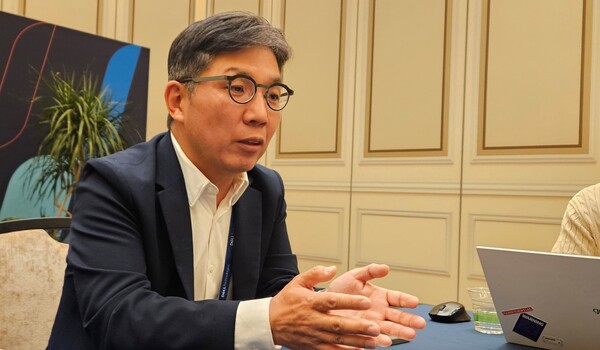
[Las Vegas, United States = DigitalToday reporter Jin-ho Lee] Naver Cloud is targeting the global business-to-business market by highlighting its capabilities in operating artificial intelligence (AI) infrastructure. It aims to seize growing AI demand in the Middle East, as well as Southeast Asia, Japan and Europe.
Naver Cloud CEO Kim Yu-won (김유원) met South Korean reporters at Dell Technologies World (DTW) 2026 in Las Vegas on May 19 (local time) and introduced the company’s global expansion plans and future market strategy.
Kim said competition in the AI market is shifting from models to infrastructure. He said global competitiveness requires combining capabilities spanning AI models, graphics processing units (GPUs), cloud, data centre operations, security and service application. "AI cloud is close to a comprehensive art form in which models, hardware, operations and services are all combined," he said. "Our goal is to supply Naver Cloud’s AI infrastructure capabilities to places around the world where they are needed," he added.
◆Targeting global markets with a customised full stack
Kim said the core of the company’s global strategy is customised AI infrastructure. The idea is to provide AI infrastructure tailored to a specific country’s culture, industrial environment and security environment. Naver Cloud has already produced results in South Korea with its graphics processing unit as a service (GPUaaS) and private AI cloud businesses. It offers a range of B2B services depending on a customer’s business goals and environment, including providing entire GPU servers, virtualising cloud services and building private AI infrastructure.
Its overseas strategy follows the same approach. It plans to diversify its market strategy to match local demand. The region Naver Cloud is focusing on most is the Middle East. It has already set up a joint venture (JV) with a local company and is accelerating its local push. It aims to expand beyond map and digital twin-based services in a super app format into AI data centres and cloud. "The Middle East is a market where we are putting in a lot of effort," Kim said. "Our goal is to grow it into a solid company that covers the entire Middle East region, not just a local entity that carries out projects," he added.
It also sees Southeast Asia as a new market. The region has relatively favourable power conditions and strong demand for building AI data centres. Kim said that because local companies often lack capabilities to build their own cloud and design software, it could become a new opportunity.
In Europe, it is placing hopes on the sovereign AI trend. "After meeting European government officials recently, it seems demand has grown stronger to directly control their own data and infrastructure," Kim said. "Amid a trend of trying not to be dependent on either the United States or China, interest in South Korea’s technology stack is also growing," he added.
◆HyperCLOVA X upgrades in the second half... "We will strike a balance between performance and efficiency"
Naver Cloud is also working to strengthen the competitiveness of its own models. It said it has secured and is operating a training cluster with 4,000 GPUs based on Nvidia Blackwell since early this year. On that basis, it plans to accelerate development of a follow-up model to HyperCLOVA X and of multimodal AI. "In the second half of this year, it is fine to expect a balanced AI model that considers both performance and efficiency," Kim said. "New lineups will also come out in areas such as multimodal, vision-language models (VLM) and omnimodal, which Naver Cloud has done a lot of so far," he added.
It said it will avoid being consumed by global benchmark competition itself. Rather than focusing on numerical competition with other companies’ large models, it will focus on making models that are useful in real industrial and corporate environments. "Comparing simply by benchmark figures is not always the best approach," Kim said. "It is important to find the point where performance and cost efficiency match best and to make models that customers can use to solve real problems," he added.
Kim also presented cooperation with Dell Technologies as an important pillar in the process. AI infrastructure is a field that requires servers, cooling, power, data centre design and operational know-how. Kim said the company will seek synergy in global expansion by combining Dell’s market network and technological capabilities built over decades.
"An AI environment is not an area a company can build on its own," Kim said. "I want to become a salt-like company that provides the most suitable AI infrastructure and services to places around the world where they are needed," he added.
 Jin-ho Lee
jhlee26@d-today.co.kr
Jin-ho Lee
jhlee26@d-today.co.kr