
TikTok will operate a cooperation channel with the National Election Commission ahead of the 9th nationwide local elections on June 3 and improve access to official election information through an in-app election centre. As election-related information spreads more on short-form platforms, it aims to reduce the spread of misinformation and AI-generated content and connect users to authoritative information.
TikTok Korea held an online briefing on May 20 and explained its framework to protect election trust and fairness and its response plan for AI-generated content. The briefing was attended by Sang-hyun Park (박상현), head of communications at TikTok Korea, Jed Horner, head of high-risk policies for TikTok Oceania and Northeast Asia, and Hee-soo Kim (김희수), trust and safety policy manager for TikTok Oceania and Northeast Asia.
TikTok's election response consists of blocking harmful content, connecting users to reliable information and cooperation with external experts and institutions. TikTok said the framework is not a temporary measure that operates only during election periods, but applies its community guidelines and safety operations, which run year-round, to the election context.
To counter misinformation, TikTok uses both automated detection technology and human review. It has a safety operations framework that supports more than 70 languages, and for Korean-language content it also draws on review capabilities that understand domestic social and political contexts. TikTok said, citing its latest quarterly transparency report, that it proactively acted on 99 percent of all removed content and that 86 percent of that was removed before any views occurred.
Content that misleads users about election procedures is a key target for action. Misinformation such as claims that certain groups cannot vote is considered a policy violation because it can hinder voter participation. Fake accounts, coordinated manipulation, content that disguises its source, and content that promotes threats, hatred or violence against election officials or specific groups are also subject to restrictions. For Korean-language misinformation responses, it is cooperating with global fact-checking organisation Lead Stories.
When Lead Stories evaluates the factual accuracy of Korea-related content, TikTok's trust and safety team applies the relevant rules. TikTok decides internally and does not leave the final decision on whether to remove content to external organisations. It is also strengthening its response capabilities on misinformation and the media environment through an Asia-Pacific safety advisory council that includes domestic experts such as Professor Young-seop Shin.
Its response to AI-generated content is also a key pillar of its election measures. TikTok requires creators to label AI-generated content that appears realistic, and it also uses content provenance verification technology such as C2PA and watermarking technology. If its own detection confirms content is AI-generated, it can also apply a label at the platform level. A label does not mean content is automatically allowed. Content that falsely depicts a real person's remarks or actions, or presents an event that did not happen as if it did, is subject to removal. Even if it does not meet immediate removal criteria, measures may apply such as limiting exposure in recommendation feeds, showing warnings before sharing, and applying an unverified label.
Separate restrictions apply to accounts related to the government, politicians and political parties. Political advertising, election fundraising and participation in creator monetisation programmes are not allowed, and indirect political advertising is also considered a policy violation. TikTok said the restrictions are intended to prevent politically motivated content from spreading excessively by combining with advertising and monetisation functions.
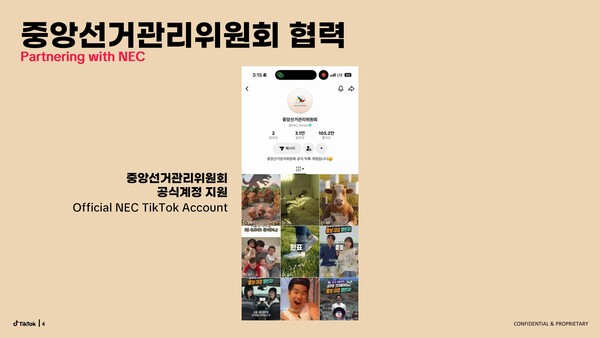
Cooperation with the election commission to link official information has also been made more concrete. Ahead of the local elections, the National Election Commission started operating an official TikTok account. The account will be used as an official channel providing election schedules, voting procedures and early voting guidance. TikTok said some election commission posts have already recorded more than 20 million to 50 million views.
TikTok also operates an in-app election information page called the Election Centre. The Election Centre is structured to link to official election commission information such as candidate information, polling station locations and early voting schedules. TikTok does not interpret and provide election information itself, but connects users to official sources. When users search for election-related keywords such as local elections, early voting and polling stations, a banner directing them to the Election Centre is also displayed.
For its reporting and response system, it operates a dedicated cooperation channel with the election commission's cyber election crime response team. Content that the election commission reports as potentially problematic is first reviewed by TikTok's trust and safety team. Even if there is a government request to remove content, it is not automatically deleted. TikTok decides whether to take action after reviewing possible violations of its community guidelines and domestic law.
TikTok said it is operating a separate task force during the election period and plans to continue the relevant response system after the election.
 Ho-jung Lee
lhj@d-today.co.kr
Ho-jung Lee
lhj@d-today.co.kr