
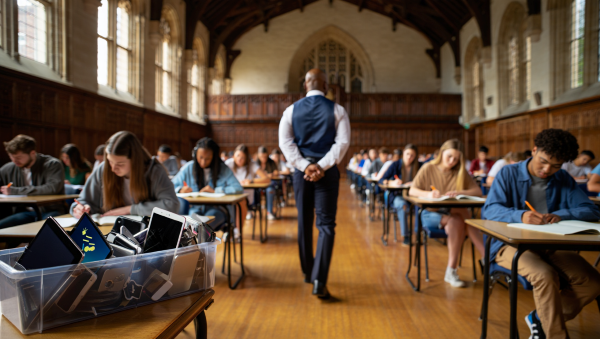
About 2 years after generative artificial intelligence (AI) became mainstream, AI-based cheating spread quickly at Stanford University. The school ultimately reinstated in-person exams in April after banning them for more than 100 years.
On May 19 (local time), foreign media outlets including online publication Gigazine reported that Theo Baker, who is set to graduate in June, said he is among the first generation to have spent college life with ChatGPT.
ChatGPT was released about 2 months after Baker entered Stanford in the fall of 2022. The service surpassed 1 million users in less than a week after it was made public and then spread quickly across student communities. Baker pointed out that after ChatGPT appeared, cheating became "easier and more profitable" than before.
On campus, various workarounds using AI were also shared. Baker said there were students who used AI to siphon off dormitory subsidies, students who pretended to be infected with COVID-19 to receive Uber Eats credits, and students who signed a pledge saying "I will not use ChatGPT" while keeping ChatGPT open in their browsers. In academic settings, AI-based cheating has already emerged as a major issue.
In a campus survey of 849 Stanford computer science students, 49 percent of respondents said they would choose to cheat rather than fail an exam. It also mentioned cases suggesting growing demand for cheating using smart glasses. This showed AI is going beyond assisting with assignments and shaking the exam and assessment system itself.
Research ethics issues have also surfaced. A Stanford student published a paper claiming results using Meta's AI model 'Llama 3-V', but there was a case in which the student actually plagiarised the open-source multimodal AI model MiniCPM-Llama3-V2.5 developed by China's OpenBMB. This is why there are criticisms that the use of AI has spread beyond learning support to research misconduct.
Schools have also changed their responses. Stanford revived in-person exams, which it had banned for more than a century, as AI-based cheating spread. A similar trend appeared at other universities. Princeton abolished a 133-year-old rule allowing professors to leave the classroom during exams as AI-driven cheating spread. An analysis says AI responses are spreading beyond individual classes into a university-wide institutional issue.
Baker pointed to a distorted incentive structure as a background to this phenomenon. With a computer science degree no longer guaranteeing entry-level jobs, junior developers feel the job market is closing and continue their studies, he explained. Concerns were also raised that an environment rewarding quick results and outward success more than academic integrity is influencing students' choices.
The flow of money in the AI industry was also mentioned as a case affecting students' perceptions. Large investments are also flowing to so-called wrapper startups that repackage other companies' models. Perplexity AI started as a service based on an OpenAI model and then surged in valuation from $1 billion (about 1.51 trillion won) in April 2024 to $20 billion (about 30.2 trillion won) in September 2025. Around Baker, a classmate even said, "I bought a house in Las Vegas because of tax measures," and there were also comments that in such an environment, "doing homework normally can feel foolish."
AI dependence among teenagers is also rising. A Pew Research survey found that a majority of U.S. teenagers aged 13 to 17 said they use AI in studying or searching for information. The lower the household income, the stronger the tendency to rely on AI, it found.
The problem of AI-driven cheating seen on college campuses is being cited as an example showing that the education system's assessment methods and reward structures themselves are being shaken, rather than being limited to misconduct at some prestigious universities.
 Seung-a Yoo
ysah@d-today.co.kr
Seung-a Yoo
ysah@d-today.co.kr