
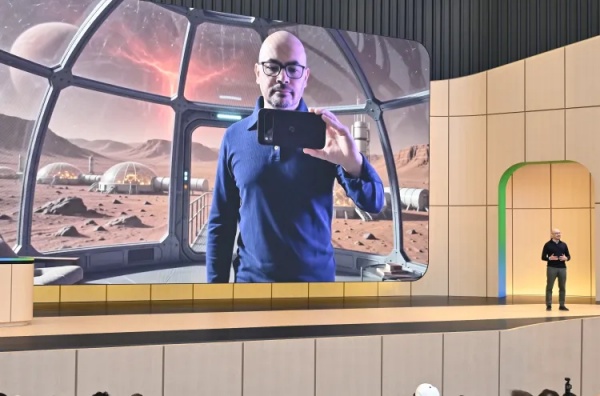
Demis Hassabis (데미스 허사비스), CEO of Google DeepMind, said the current period could be seen as the “start of a singularity” in the era of artificial intelligence. An interpretation has emerged that Google is beginning to define AI as a turning point for humanity rather than a simple service innovation.
On May 19 local time, IT outlet The Verge reported that Hassabis said at the end of the keynote speech at Google I/O 2026, “When we look back later, now may seem like the time we were standing at the start of the singularity.” He then described it as “a significant moment for humanity.”
The remarks are drawing attention because Google explained its recently unveiled AI research and products by linking them to a long-term vision for AGI, or artificial general intelligence. In the speech, Hassabis stressed that Google’s latest research and products would “help unlock the potential of AGI for the whole world.”
He also introduced Gemini for Science, a collection of AI tools to support scientific research, just before the keynote, expanding AI’s role into the scientific research domain. The tools consist of experimental and research functions provided based on Google Labs and Google Antigravity.
Hassabis argued that AI could fundamentally change how scientific research is done. In the long term, he said he hopes to “reimagine drug discovery with the goal of someday solving all diseases.” It means positioning AI not as a simple tool to improve productivity but as a core foundation for scientific discovery and problem solving.
The “singularity” Hassabis referred to differs somewhat from the commonly known concept. In an interview with Bloomberg just a few months ago, he explained that the singularity is “another way of expressing reaching full AGI.” He noted that it differs in tone from the traditional singularity concept used by Ray Kurzweil or Vernor Vinge.
At the time, Hassabis also said the current level of technology is still far from that stage. He maintained his earlier outlook that there is about a 50 percent chance AGI could be achieved by 2030, but said, “We are still a long way from it.”
For that reason, the latest remarks are also interpreted as an attempt to explain recently unveiled AI research and products within a broader long-term vision rather than an official declaration that AGI is imminent. In the speech, Hassabis described AI as an “amplifier” that strengthens human creativity and problem-solving ability.
He stressed that AI technology could open a new golden age of scientific discovery and technological progress and ultimately improve the lives of people around the world.
At the event, Google put AI for scientific research at the forefront, appearing to broaden the focus of AI competition from search, productivity and consumer services to research and discovery. Against that backdrop, Hassabis’ “start of a singularity” remark is also interpreted as a signal that Google is beginning to link AGI discourse to product announcements. Still, as Hassabis himself has said until recently that reaching AGI is still far off, a key point to watch is what research results and products Google will use to support the remark going forward.
 Jinju Hong
hongjj@d-today.co.kr
Jinju Hong
hongjj@d-today.co.kr