
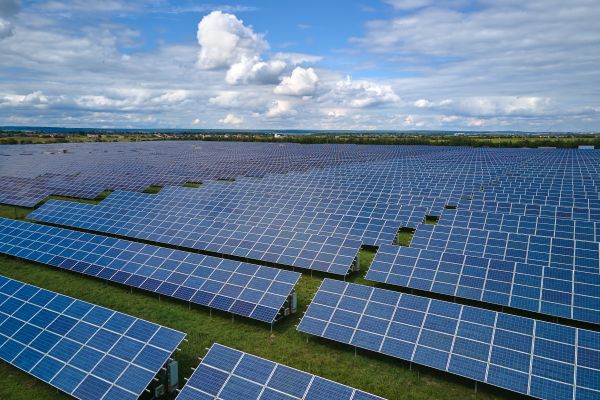
Solar power is expected to rise to become the world’s largest source of electricity within the next 10 years, surpassing coal, oil and natural gas, an outlook said. Even so, fossil fuels are also likely to keep a role over the medium to long term due to a surge in data centre power demand driven by the spread of artificial intelligence (AI), it said.
On May 19, U.S. tech media outlet TechCrunch reported that BloombergNEF said in a recent report that by 2035 solar would establish itself as a key energy source in the global power market on economics alone.
The central driver is cost competitiveness. BloombergNEF said the falling unit cost of solar power means the energy transition can proceed naturally even without strong regulation. Matthias Kimmel, head of energy economics, called it "solar is winning the competition".
Examples are also emerging. Pakistan added about 25 gigawatts (GW) of new solar capacity over the past two years after natural gas prices surged following the Russia-Ukraine war.
The expansion of solar is unfolding alongside a broader push to electrify industry and rising demand from AI-based data centres. Data centres in particular are cited as the fastest-growing source of electricity demand in the energy sector.
BloombergNEF said the expansion of data centres would drive demand for new generation capacity including 1 terawatt (TW) of utility-scale solar and an additional 400 GW of solar, 370 GW of natural gas and 110 GW of coal.
But the around-the-clock power requirements specific to AI data centres were cited as a factor that could slow the pace of a shift centred on solar. The report expects natural gas and coal to account for about 51 percent of additional generation for data centres through 2050. That means solar, which is affected by weather and time of day, is unlikely to fully replace stable baseload power.
As a result, competition over future power infrastructure is shifting beyond simply expanding solar to securing energy storage technologies. In Spain and Italy, electricity prices fell as daytime solar supply surged, weakening the profitability of standalone solar plants. The industry is therefore shifting toward building hybrid plants that combine solar and batteries.
BloombergNEF said the battery market is now in an early growth stage similar to the solar market around 2020. Grid-connected batteries installed worldwide last year totalled 112 GW, and it forecast that figure would expand by nearly three times by 2035. In this trend, Redwood Materials and Ford are also moving to expand energy storage businesses.
Solar costs are also expected to keep falling. BloombergNEF expects solar generation costs to drop by an additional roughly 30 percent by 2035. It also suggested that by 2050 solar generation could exceed twice that of natural gas.
The backdrop to the cost declines was attributed to China’s large-scale production system and industrial policy. Kimmel said costs generally fall as installed capacity doubles, but solar has declined faster than that.
The report said it did not fully reflect the latest deterioration in Middle East conditions and geopolitical factors related to Iran. Even so, BloombergNEF said an economics-driven energy transition could, over the long term, lead toward lower dependence on energy imports across countries.
The industry sees the outlook as showing both a solar-led energy transition and the possibility that the massive around-the-clock power needed by AI data centres could slow the exit of fossil fuels. It expects the key competitive field to be how much supplementary power sources such as batteries, long-duration storage, geothermal and nuclear can replace data centre demand rather than solar itself.
 Jinju Hong
hongjj@d-today.co.kr
Jinju Hong
hongjj@d-today.co.kr