
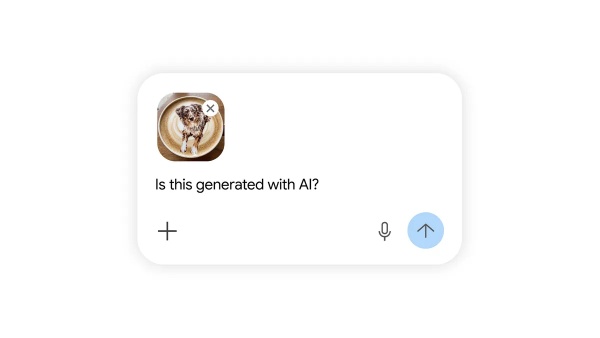
[DigitalToday reporter Yoonseo Lee (이윤서)] Google is expanding AI-generated image identification in Android’s Circle to Search, as well as in Google Lens, Chrome and Search.
IT outlet Engadget reported on May 19 that Google is widening the rollout of the feature based on its proprietary watermarking technology SynthID, making it easier to verify images created by AI or edited with AI.
The focus is mainstreaming image source verification. The feature, previously offered mainly through a dedicated SynthID detector or the Gemini app, is expanding to Search, browsers and mobile visual search. Android users will be able to use Circle to Search, which searches by long-pressing an image on the screen, to check whether content is AI-generated. Gemini in Google Lens and Chrome can also answer questions such as, "Was this image generated by AI?"
Google said the feature is not limited to simple detection and can, in some cases, show detailed history. In an example the company presented, users could see information that a specific image was first taken with a Pixel phone and later edited with AI-assisted tools in the Google Photos app.
SynthID is a watermarking system that attaches invisible metadata to content created or modified with Google AI tools. After unveiling a dedicated SynthID detector at last year’s I/O, Google integrated the feature into the Gemini app and is now expanding it to Chrome and Search.
Google said it does not provide the same level of detection accuracy and history information for all AI-edited images. It has introduced Content Credentials, an industry-standard watermarking framework, into the base camera app on the Pixel 10 and is expanding it to the Pixel 8 and Pixel 9. Source information is relatively rich for images shot and edited on its own devices and services, but there may be limits in identifying content made on other AI platforms in the same way.
Google is also expanding integration with outside companies to reduce those limits. It said OpenAI, Kakao and ElevenLabs will apply SynthID technology to more AI-generated content. OpenAI disclosed in a blog post that it will begin integration starting with images made with ChatGPT, Codex and the OpenAI API.
Support for Content Credentials is also expanding. Google has begun supporting Content Credentials in the Gemini app, and plans to add integration with Chrome and Search within the next few months. It is stepping up a strategy to broaden AI image identification by using both SynthID and a separate industry-standard framework.
Google said watermark-based identification technology is not a complete solution. It also acknowledged that no AI watermarking system is perfect, and there are many ways to bypass detection tools or watermarks. Even so, as AI-generated content becomes more sophisticated and spreads quickly, it appears to be focusing on expanding ways for users to double-check what process an image in front of them has gone through.
 Yoonseo Lee
yslee@d-today.co.kr
Yoonseo Lee
yslee@d-today.co.kr