
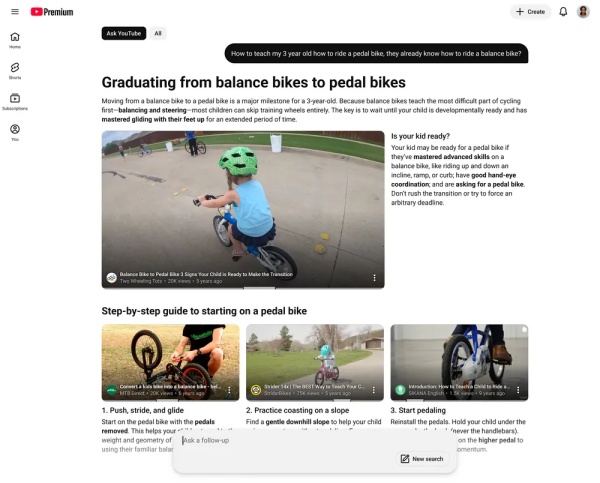
Google is introducing an interactive artificial intelligence (AI) search feature on YouTube called Ask YouTube.
On May 19 local time, IT outlet TechRadar reported that Google unveiled the feature at Google I/O 2026 in California. When a user enters a question, Gemini finds a suitable video and jumps directly to the relevant segment.
While existing YouTube search is built around finding videos by specific titles or keywords, Ask YouTube organises results by taking questions like a chatbot. Users do not need to break search terms into short fragments.
An example Google presented was a question such as: "How do I teach a 3-year-old to ride a pedal bike? They can already ride a balance bike." In that case, the service first shows a written answer like a general AI chatbot, and places related YouTube videos below it. Users can read the answer while watching videos to check the information they need.
Google explained that the goal is "to make information easier to understand and to find what you want quickly." It is an approach aimed at reducing the video discovery process rather than simply listing search results.
The initial launch will be limited to the United States. U.S. users will be able to use Ask YouTube this summer, and users who are used to the existing method can continue using YouTube as they do now without pressing the new Ask YouTube button.
The feature could affect not only users but also YouTube creators. While titles, thumbnails, descriptions and keywords have played a big role in search-driven traffic, Ask YouTube could make video content and the suitability of answers in specific segments more important. That means videos that directly answer questions could be more likely to appear in AI search results.
Ask YouTube could also further blur the line between Google Search and YouTube search. Rather than separately searching webpages and videos to find information, users can check a text answer and video evidence within a single question. For Google, it can be seen as an extension of a strategy to connect Gemini across major services such as Search, Chrome and YouTube.
This change, which combines Gemini with YouTube, is seen as an attempt to shift video discovery from a list of search results to conversational questions and answers. It is expected to be especially useful for long questions, questions with lots of context, and questions that are hard to organise into precise keywords. Its practical effectiveness, however, depends on how well Gemini selects appropriate videos after the U.S. launch and how far it can improve the accuracy of links to key segments.
 Yoonseo Lee
yslee@d-today.co.kr
Yoonseo Lee
yslee@d-today.co.kr