
Google has unveiled an artificial intelligence shopping tool called Universal Cart that brings multiple retailers together around Search and Gemini.
On May 19, local time, IT outlet The Verge reported that Google introduced commerce features at Google I/O spanning unified carts, price tracking, checkout recommendations and AI purchase delegation.
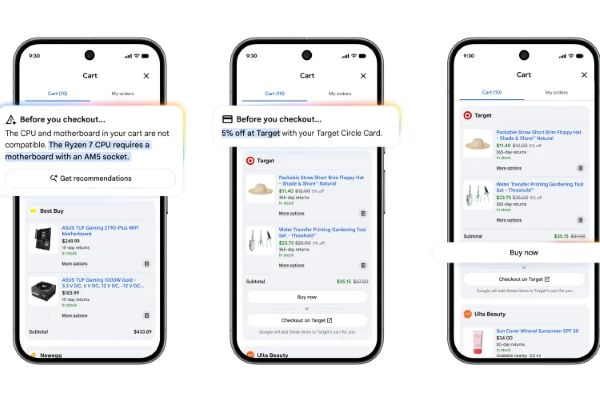
Universal Cart is designed to let users place products they find while searching or chatting with Gemini into an in-Google cart and later proceed to payment through Google. It currently works mainly through Search and Gemini, and is set to expand so users can add products to the cart from YouTube and Gmail. A cart icon appears next to the user’s profile photo.
Google is positioning the core of the feature as integrating fragmented shopping experiences into one. Vidhya Srinivasan (비드야 스리니바산), Google’s vice president and general manager for Ads and Commerce, said users shop over several days while switching across devices and accounts, and that “bringing all of that together” is the key. She emphasized that Universal Cart will become “a cart you can use anytime, anywhere across Google services.”
The features go beyond simple saving. Products placed in the cart can receive price-drop alerts, view price history and get restock notifications for out-of-stock items. It also detects purchase-combination issues. For example, if a first-time PC builder selects incompatible parts, the system warns them.
At checkout, users can connect retailer memberships and credit cards through Google Pay, and the system recommends payment methods that can save money. Even if users do not pay within Google, they can transfer cart information to a retailer’s website to complete the purchase. Srinivasan explained that retailers can provide additional information on their own sites, where users can explore in more depth.
Google is also expanding a function in which AI executes purchases directly based on user criteria. It has offered direct purchase features in Search’s AI mode and in the Gemini app, and is expanding them into hotel reservations and local food delivery. Through a personal AI agent called Gemini Spark, users can set brand preferences, product conditions and budgets, and the AI can automatically complete purchases when the conditions are met.
The feature runs on AP2 technology. When AI makes a purchase, it includes an approval process and leaves records. Users can set desired product conditions and a price ceiling and have automatic purchases executed when the conditions are met.
Cooperation with the retail industry is also expanding. Google announced an open standard universal commerce protocol, UCP, in January with Walmart, Shopify and Target, and in April Amazon, Meta, Microsoft, Salesforce and Stripe joined the steering committee. Google said it does not charge fees or commissions for purchases through its system and does not want to be a party to sales records.
Challenges remain. Even if AI selects a product that meets budget conditions, it could be more expensive than other options once taxes and shipping are included. If problems arise after a purchase, the party responsible for resolving them is the retailer, not Google. Building consumer trust is cited as a key task if AI is to handle payment as well as recommendations.
 Seung-a Yoo
ysah@d-today.co.kr
Seung-a Yoo
ysah@d-today.co.kr