
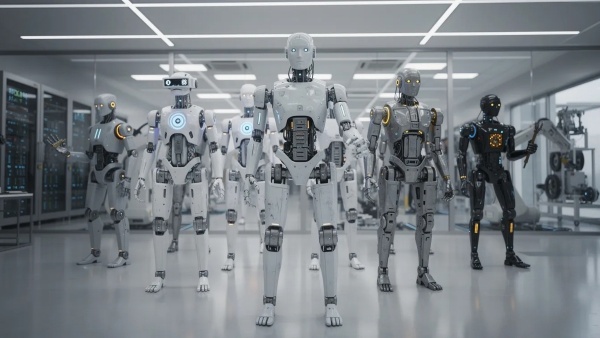
Japan's manufacturing sector is treating factory floors as a key arena for the next AI race and is speeding up efforts to advance robot automation. While the United States and China lead competition in large AI models and semiconductor infrastructure, Japan is moving to pre-empt the industrial AI market by leveraging manufacturing data and robotics technology.
On May 19, blockchain media outlet Cryptopolitan reported that Japanese companies have recently focused on shifting factory automation systems around "Physical AI". Physical AI refers to AI that can perceive the real world, judge situations and act autonomously in real time while collaborating with humans. Traditional industrial robots are specialised in repetitive work, while Physical AI aims to expand into complex and unpredictable tasks.
The most proactive moves have come from Japanese industrial robot maker Fanuc. On May 13, Fanuc unveiled a plan to work with Google to develop AI robots that understand voice or handwritten instructions and autonomously carry out factory tasks. It said it is developing a system based on Google's AI model Gemini that would allow factory robots to be operated without programming skills.
Fanuc plans to make its robots compatible with Google's software and open to outsiders a robot software system it has operated in a closed manner. It previously announced a collaboration with Nvidia in December. Kenichiro Abe (아베 겐이치로), a Fanuc managing executive officer, said, "There were limits to building the entire AI ecosystem on our own," adding, "We are shifting our strategy to using AI systems from multiple companies together."
A key asset Japan is counting on is manufacturing-floor data accumulated over a long period. Japan's manufacturing industry has relied for decades on tacit knowledge and know-how of skilled workers, and work is now accelerating to convert that into AI training data. Nomura Securities assessed that Japan's long production experience and factory data could become the basis of competitiveness in industrial humanoid robots.
Still, the market environment is not easy. The International Federation of Robotics said Japanese manufacturers' share of the global industrial robot market fell to around 40 percent now from about 80 percent in the 1990s. Growth by Chinese companies stands out. Chinese firms including Estun Automation and Inovance Technology are rapidly expanding their share of the humanoid robot market.
Even so, Japan sees potential for a comeback based on precision motion-control technology, key robot components and competitiveness in semiconductor equipment. Many Chinese robot makers are still known to depend on Japanese machine parts.
Japanese companies are also moving to build industrial AI platforms that combine cloud and software, shifting away from a hardware-centric structure. Japanese technology company ARUM Inc is developing a fully automated production line for manufacturing metal parts called TTMC and is pushing to expand in Japan and overseas markets. Industrial equipment company Fairy Devices is collecting work data from skilled technicians through wearable AI devices and using it to train AI models for specialised work.
The Japanese government is also stepping in. Prime Minister Sanae Takaichi said at a New Year press conference this year that it planned to accelerate innovation in Physical AI and spread it to global markets. The idea is to use high-quality data in Japan, especially factory know-how accumulated over a long period, for training AI robots. After announcing a policy in December 2025 to support domestic production of general-purpose AI models, the government plans to invest 1 trillion yen over the next 5 years to back development of Japan-style Physical AI.
The industry assesses that Japan's AI strategy is unfolding in a different direction from the U.S.-style race for large models. It is behind in the competition over its own large AI, but still has strengths in manufacturing and robotics that apply AI to production sites. Analysis says Japan's battleground is on factory floors, not inside data centres.
 Jinju Hong
hongjj@d-today.co.kr
Jinju Hong
hongjj@d-today.co.kr