
With this year marking the first year of mass production for humanoids, robot battery supply methods are splitting into two camps: swappable batteries and integrated, high-energy-density packs. South Korea's three battery makers Samsung SDI, LG Energy Solution and SK On have built portfolios that can respond to both camps and are joining a race for orders.
Global humanoid shipments are expected to expand from 13,000 units this year to 500,000 in 2030 and 4 million in 2035, according to Kiwoom Securities. Humanoid batteries installed in these robots operate for an average of 2 to 4 hours on a single charge. If high-load tasks such as walking and lifting continue, actual operating time falls to 1 to 2 hours. Given that shift work standards at industrial sites are 8 to 12 hours, securing operating time is a key task for replacing human labor. Two solutions to this issue have become the fork in battery supply methods.
The swappable approach replaces batteries quickly. It is suited to industrial sites such as factories and logistics centers that require 24-hour operation. In specifications released by major companies, Boston Dynamics' Atlas is designed to enable autonomous swapping within 3 minutes, and Apptronik's Apollo supports battery replacement within 5 minutes and hot-swap. Chinese players are taking the same route. Unitree's H1/G1 uses a 30-second quick-release, and AgiBot's A2 series and UBTech's Walker S have adopted hot-swap.
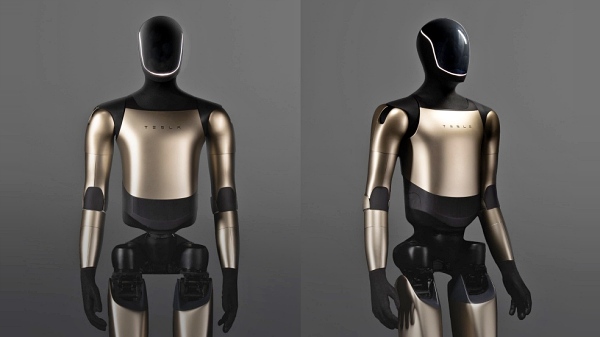
The integrated approach, by contrast, is designed to run longer on a single charge. Unlike the swappable approach, it is designed to avoid frequent battery replacement in home and service environments and to boost charging efficiency. Tesla's Optimus is developing autonomous charging docking with specifications of a 2.3 kWh battery and a 2 to 2.5 hour full charge using a standard 120V outlet. Figure AI's F03 has a 2.3 kWh battery, 2 kW fast charging and an active cooling system. 1X Technologies' Neo (NEO) uses autonomous docking, in a structure where 1 hour of charging fills 6 minutes of usage.
Kiwoom Securities analyzed that the dividing line between the two camps lies in the operating environment. In a 24-hour full-operation environment, the swappable approach is reasonable because it minimizes downtime by operating with 1 to 2 spare batteries, it said. In home and commercial use, an integrated high-energy-density pack that extends single-battery operating time is advantageous, it added. It also said actual battery demand per robot should be seen at around 6 to 7 kWh, including replacements and spare packs, rather than the installed capacity itself of 2.5 kWh.
◆K-battery trio responses diverge with all-solid-state, high-nickel
This bifurcation of battery standards is also creating splits in battery chemistry. In the medium to short term, adoption rates of high-nickel ternary batteries and silicon anode materials will rise, and in the long term, all-solid-state batteries are expected to establish themselves for humanoids, according to Kiwoom Securities. Lithium iron phosphate (LFP) is disadvantageous for humanoid structures that require about 52V because it has low energy density and voltage and a large cell size.
South Korea's three battery makers have already put forward cards that can respond to both camps at the same time. Samsung SDI unveiled its all-solid-state brand "Solid Stack" at InterBattery 2026 and stressed it can extend robot operating time to 8 hours. It kept the mass-production timeline at the second half of 2027 and set humanoids, high-altitude platform stations (HAPS) and drones as priority application markets ahead of electric vehicles. LG Energy Solution presented a 2030 all-solid-state mass-production roadmap, and SK On set 2029.
Commercial lineups are also already in operation. SK On showcased a case at InterBattery 2026 in which it supplied high-nickel ternary batteries to Hyundai Wia's autonomous mobile robots (AMR), enabling up to 8 hours of operation on a single charge. LG Energy Solution installed batteries in LG Electronics' next-generation home robot "CLOiD". LG Energy Solution is also estimated to be a battery parts supplier in Tesla Optimus' value chain, according to Eugene Investment & Securities.
Global humanoid-battery demand in 2030 is 3 to 8 GWh. TrendForce projected 14 GWh in the same year and expansion to as much as 100 GWh by 2035, and analyzed that all-solid-state batteries will account for 74.2 GWh of that. The absolute scale is small compared with the electric vehicle market, but humanoids have shorter charge-discharge cycles than EVs due to their usage patterns, creating a structure in which replacement demand occurs repeatedly. That makes early capture important.
The key is 2027 to 2028. Tesla plans a full ramp-up in 2027 after starting Optimus production in July to August 2026, and Boston Dynamics aims to produce 30,000 units a year in 2028. Samsung SDI's timing for all-solid-state mass production, set for the second half of 2027, will coincide with the full-scale ramp-up of humanoid mass production. An industry official said, "The order landscape will be divided depending on which camp's standard the three K-battery makers pre-empt."
 Seok Dae-geon
d2dg@d-today.co.kr
Seok Dae-geon
d2dg@d-today.co.kr