
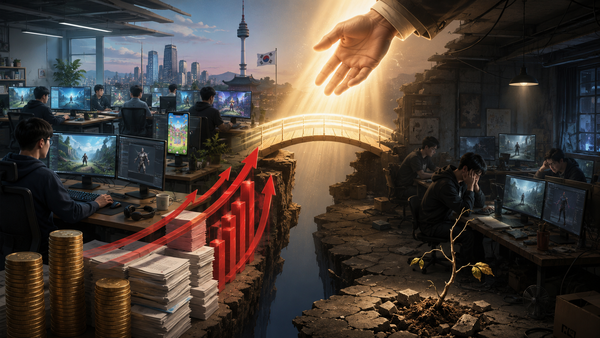
Games, which account for 60 percent of South Korea's content exports, have been excluded for years from production cost tax credits, fueling calls for changes to the system. Production cost tax credits already apply to video content and webtoons, but not to games, drawing criticism that small game developers are going bankrupt as development costs surge. The Ministry of Culture, Sports and Tourism has submitted a tax expenditure proposal to the Ministry of Economy and Finance, and related legislation is being pursued in the National Assembly, focusing industry attention on whether it will be institutionalised.
According to the ministry's '2025 Content Industry Survey (based on 2024)' released in February, games accounted for $8.50 billion, or 60.4 percent, of the country's total content exports of $14.08 billion.
South Korea ranks fourth in the world with a 7.2 percent share of the global game market. The game industry is a key export sector that accounts for more than half of South Korea's content exports. Despite those results, there is no separate production cost tax credit targeting costs directly投入 into game production.
Some tax credits apply in the game industry to part of research and human resources development (R&D) spending, but there is no system that separately deducts game content production costs. Production cost tax credits apply to video content such as films and dramas and to webtoons, but games are excluded as a separate category. The industry has urged formal adoption for years, but efforts have repeatedly failed to pass the National Assembly.
◆With growth at 1.1 percent, bankruptcies among smaller firms continue; cracks in the ecosystem become visible
Despite surface-level results, the inside of the game industry is thinning quickly. According to the Korea Creative Content Agency, total game industry sales in 2025 were 24.124 trillion won, up only 1.1 percent from a year earlier. That was less than half the overall content industry growth rate of 2.6 percent, and the gap with music (15.8 percent) and comics (7.4 percent) was also wide. The game usage rate fell 9.7 percentage points to 50.2 percent in 2025 from 59.9 percent in 2024. From 2021 to 2025, the game usage rate fell an average of 6.8 percent a year.
The crisis is becoming visible first among small and mid-sized developers. 'Goddess Order,' released in September last year, halted all updates within 5 to 6 weeks of launch, and its developer PixelTribe was declared bankrupt in December that year. 'Heaven Hells,' unveiled in February, ranked No. 1 in Google Play Store downloads but stayed outside the 140s in sales rankings, and developer Clover Games applied for corporate bankruptcy in early April. If initial sales fail to materialise, updates shrink, users leave and fundraising is blocked, repeating a vicious cycle.
The burden of development costs is also rising each year. As PC, mobile and console multiplatform development becomes common, it has become frequent for a single project to receive investment of more than tens of billions of won. The burden is growing further with the added costs of adopting AI and upgrading graphics. Large companies with dedicated organisations and investment capacity cut costs through AI, while smaller developers face the cost of adopting AI itself. Without policy support such as tax credits, this structural gap is likely to deepen over time.
In the industry, views have been raised consistently that the current structure, in which games responsible for 60 percent of content exports are excluded from production cost tax credits unlike video content, also poses a problem of fairness. Major game powerhouses such as France, Canada and the UK already operate systems that provide tax credits for a certain percentage of game production costs. In China, the world's largest game market, massive policy funds are being投入 to support the development of domestic game companies. That is the backdrop to criticism that it is hard to see domestic companies as competing on equal terms when they must compete with overseas game companies backed by such support without production cost tax credits.
◆Tax expenditure proposal submitted, bill introduced; will the finance ministry open the door this time
Moves have emerged recently suggesting discussions on tax credits are advancing to a concrete stage. The Ministry of Culture, Sports and Tourism submitted a tax expenditure proposal to the Ministry of Economy and Finance in April to introduce a production cost tax credit for game content. At the second meeting of the Culture and Arts Policy Advisory Committee's game subcommittee held on April 30, introducing the tax credit was addressed as one of the key agenda items.
Culture Minister Hwi-young Choi (최휘영) mentioned the game industry's large share of K-culture content exports and said, "A tax credit is one of the ways to promote a business." On concerns about a fall in tax revenue, he said, "We will consult with the finance ministry from the perspective that tax revenue does not decrease through a tax credit, but that the industry is promoted and added value grows further."
"For growth in the game industry, which accounts for more than 60 percent of content export value, the situation makes concentrated government investment and institutional support more urgent than ever," Choi also stressed.
Legislative moves are also continuing in the National Assembly. People Power Party lawmaker Seong-hoon Park (박성훈) introduced on May 7 an amendment to the Tax Exemption and Reduction Control Act to expand the scope of production cost tax credits to broader cultural content including games and music.
The amendment also includes provisions reflecting the game industry's characteristics, where continuous updates are essential, allowing ongoing content that has not been completed to immediately receive deductions for costs incurred in the relevant tax year. In e-sports, it also includes clauses to expand tax credits for tournament operating costs, previously limited to areas outside the Seoul metropolitan region, to nationwide coverage. If more than 50 percent of all matches are held outside the metropolitan area, the credit rate would be raised from 10 percent to up to 30 percent.
Earlier, rival party lawmakers each introduced related bills last year, but they were scrapped without including games. The industry is also watching that views are spreading in politics that the game industry is a future content industry and an area to strengthen national competitiveness, and that discussion bodies such as the Democratic Party's special committee on games have been established.
If the tax credit is introduced, the industry estimates benefits of more than 200 billion won a year. There is strong expectation that not only major game companies but also smaller developers could reduce production cost burdens to some extent, leading to more active investment in new titles and wider development of intellectual property (IP).
The finance ministry's position is that the game industry already receives existing tax support such as R&D tax credits, so introducing a production cost tax credit could result in overlapping support. In response, the industry counters that while R&D tax credits apply only to technology development, production cost tax credits target overall actual content production costs such as character design, story planning and sound production, making the purpose and scope fundamentally different.
Whether the expected decrease in tax revenue from introducing the tax credit can be offset by added value creation through revitalising the industry is expected to become the core issue in the debate.
Support exists for early-stage startups and indie games, but policy support is insufficient to connect stages in which small developers become mid-sized and mid-sized firms again challenge global markets. That is why consecutive bankruptcies among small developers do not end with the disappearance of a single company. It is because the ground for new IP, genres and next-generation development talent to grow is narrowing together. How the culture ministry's submission of the tax expenditure proposal and the National Assembly's bill introductions move the finance ministry is expected to be a turning point in the discussion.
An industry official said, "With bankruptcies among small developers continuing and more cases of development projects being halted, without institutional support such as tax credits, the space itself for new IP and genres to emerge could narrow." The official added, "It is a time when a minimum policy foundation is needed to sustain the game ecosystem."
 Hojeong Lee
lhj@d-today.co.kr
Hojeong Lee
lhj@d-today.co.kr