
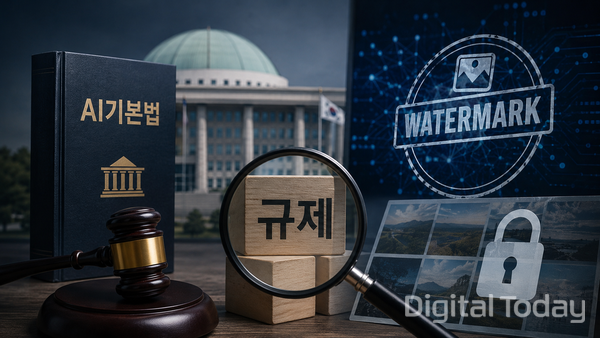
In South Korea's parliament, bills to strengthen regulation of artificial intelligence (AI) watermarks are being introduced one after another.
Kim Dae-sik (김대식), a lawmaker from the ruling People Power Party on the National Assembly Education Committee, recently introduced an amendment to the Framework Act on the Development of Artificial Intelligence and the Establishment of a Trust Foundation (AI Basic Act). It specifies the current AI Basic Act's watermark display obligation for AI businesses by requiring a code, text or symbols that users can clearly identify to be inserted into the output itself. It includes criminal penalties, including a fine of up to 20 million won for damage, forgery or alteration.
Cho In-cheol (조인철), a lawmaker from the Democratic Party on the National Assembly Science, ICT, Broadcasting and Communications Committee, introduced earlier this year an amendment to the Act on Promotion of Information and Communications Network Utilization and Information Protection (Information and Communications Network Act). It is centered on banning damage, forgery and alteration of watermarks when distributing AI-generated content. It requires not only AI technology businesses but also platform operators above a certain size to support watermarks and take technical measures to prevent damage, forgery and alteration. Administrative fines for violations are up to 10 million won.
The parliament's moves stem from limits in current regulation. The AI Basic Act imposes a watermark display obligation on AI businesses, but rules for the distribution stage are supplemented by separate guidelines.
The Ministry of Science and ICT released AI Transparency Guidelines on Jan. 22 along with the enforcement of the AI Basic Act. It presented specific methods, allowing only visible, perceptible watermarks for deepfake outputs and requiring logos to be displayed across the entire AI-edited playback segment for video deepfakes. But the guidelines are administrative guidance and have no legal binding force. Failing to meet the display obligation can result in administrative fines, but there is no basis for punishment even if a watermark is damaged, forged or altered during distribution.
The regulatory gap in distribution is also evident on the user side. Content such as 'watermark removal methods' is spreading through social media and YouTube. Methods of removing markings using built-in tools in Windows or Mac operating systems are being shared, making it easy to remove watermarks and raising concerns about misuse.
Calls are also growing to strengthen standards for AI-generated content that can be used for crimes, such as deepfakes. The National Office of Investigation at the National Police Agency said 1,827 deepfake sex crimes occurred from November 2024 to October 2025, with 1,438 people arrested. That was an increase of 50.1 percent in detected cases and 47.8 percent in arrests compared with November 2023 to October 2024. Separately, data submitted by the Korea Communications Standards Commission to Cho's office for last year's 국정감사 showed the number of reviews of deepfake sex crime videos surged to 23,107 in 2024 from 1,913 in 2021.
Major countries overseas are moving to expand obligations to attach watermarks to AI-generated content. The U.S. state of California requires ensuring the permanence and irreversibility of AI-generated content labels and mandates the provision of free detection tools so general users can verify whether content was AI-generated. China manages both the generation stage and distribution process and assigns management responsibility to platform operators as well. The European Union also uses a 'robust watermark' approach as the standard, applying visible and invisible labels together.
Experts point to a legislative gap on watermarks from two angles: platform regulation and user responsibility. Lee Seong-yeob (이성엽), a professor at Korea University's Graduate School of Technology Management, said, "Current law imposes watermark obligations only on AI development and usage businesses, leaving platforms such as YouTube outside the scope of regulation," and suggested introducing the concept of a distributor as a solution. He added, "It is also a task that there is no basis for sanctions even if general users delete or damage deepfake watermarks," and "separate legislative review is needed, such as including AI-generated content regulation in the user protection provisions of the Broadcasting Media and Communications Review Committee."
 Son Seul-gi
sageson@d-today.co.kr
Son Seul-gi
sageson@d-today.co.kr