
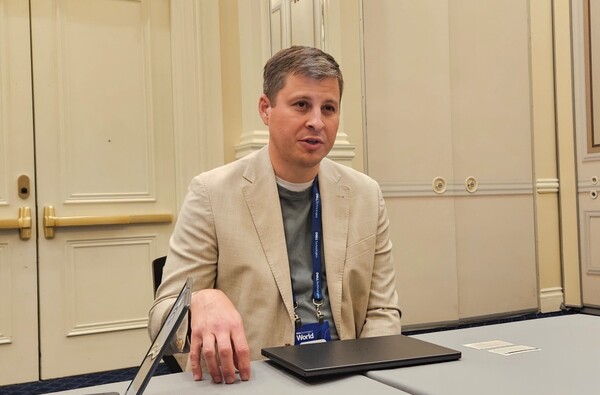
[Las Vegas, U.S. = DigitalToday reporter Jin-ho Lee] "In the era of artificial intelligence (AI), the core of security does not end with stopping attacks. What matters is how quickly you detect and respond to breaches, and in what order you restore data."
John Scimone (존 시모니), president and chief security officer (CSO) of Dell Technologies, said this when he met South Korean reporters on May 18 (local time) at Dell Technologies World 2026 (DTW26) in Las Vegas, the United States.
Scimone stressed that as companies accelerate AI adoption, zero trust should not be seen only as a defensive system. "It is true that many zero trust principles have focused on protection in cybersecurity strategy," he said. "But zero trust principles apply to all areas of cybersecurity. Dell is applying zero trust capabilities not only to internal security operations but also to products and solutions," he added.
◆Cyber resilience importance rises... breach response process is key
Scimone particularly highlighted recovery capability. While blocking attacks used to be the top priority in corporate security strategy, in the AI era the ability to recover on the assumption of a breach is becoming more important, he said. "In the industry, protection was often placed as the top priority when setting security priorities," he said. "But what customers see as most important now is a high level of cyber resilience," he added.
He stressed that the most important thing in a crisis is "order." Key indicators are whether the most important things are being restored in the right order and how quickly they are restored, he said. For example, to normalise corporate operations after a ransomware attack, simply retrieving data is not enough. Companies need to identify in advance which data is critical, which tasks should be restored first and how dependencies between applications and infrastructure are connected.
On AI security, he pointed to the importance of data management. In the process of training and using AI, sensitive data and unstructured data are often used together. He said accurately identifying the location, nature and sensitivity of data must come first to achieve both compliance with industry regulations and data control.
Scimone said "private data" will affect companies' future competitiveness. He said this trend is also linked to on-premises AI demand. He said companies adopting AI increasingly want to control their data internally without sending it outside.
"(Companies) need to understand what data they have, how sensitive it is, whether it is subject to regulation and whether there are compliance requirements," he said. "On that foundation, they need to design AI systems in a responsible way," he added.
◆AI security also hinges on fundamentals
As companies adopt more AI, AI models themselves are becoming targets of attack. Scimone said AI security also requires properly applying existing security principles rather than completely new ones. "Customers need to be able to trust the technology to actively embrace the benefits of AI," he said. "It is important to embed security from the initial design stage and carry it through the entire lifecycle," he added.
Dell cited its products and services and its real-world incident response experience as differentiators in its security strategy. It said it does not stop at providing storage or data protection solutions, but reflects forensic information and threat tactics gained during ransomware incident response in product development.
For example, if a customer suffers a ransomware incident, it uses the attack tactics to set its security strategy again. "We learn sophisticated tactics of threat actors in the field and reflect them back into solution design," he said. "Inside Dell, there are hundreds of cybersecurity experts," Scimone said. "They are deeply involved in customer security operations, consulting, incident response and recovery," he added.
"Without a trusted cybersecurity programme, companies cannot confidently pursue their technology strategy," Scimone said. "Cybersecurity is an element that enables digital transformation," he added.
 Jin-ho Lee
jhlee26@d-today.co.kr
Jin-ho Lee
jhlee26@d-today.co.kr