
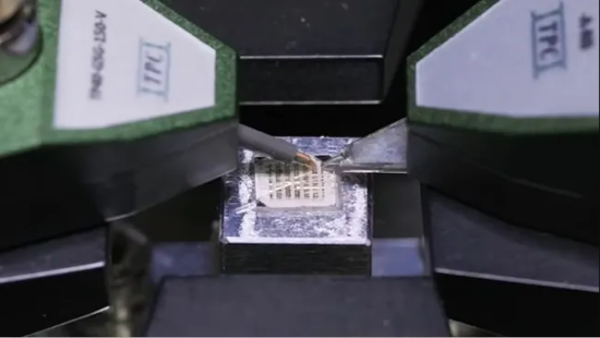
A University of Tokyo research team has developed a next-generation semiconductor device that can boost information-processing speed by up to 1,000 times while barely increasing heat generation. It is drawing attention as a next-generation low-power computing technology, raising the possibility of overcoming the speed and heat limits of existing semiconductors at the same time.
On May 18 local time, IT outlet TechRadar reported that the team developed a "non-volatile quantum switching device" that records data by using the magnetic properties of electrons instead of electric current.
The core of the development is that it addressed speed and heat at the same time. The researchers said experiments showed the device processed 1-bit information in about 40 picoseconds. Given that existing semiconductors are at about 1 nanosecond, this marks a sharp improvement in processing speed.
It also reduced heat. Existing chips often hit performance limits because heat generation rises sharply as speed increases. The researchers explained that the new device can significantly lower heat generation because it records information by using changes in magnetic orientation rather than a continuous flow of electric current.
The device structure is based on tantalum and manganin materials. When an electrical signal passes through a tantalum layer, a very small change in magnetic orientation is recorded inside the manganin, and that orientation itself serves as a data bit. The researchers said this structure allowed ultra-fast processing and low-power characteristics at the same time.
Durability also differed. The researchers said the device operated stably even after more than 100 billion repeated operations. The outlet reported that existing high-speed semiconductors can face overheating problems after about 10 million cycles under similar conditions. It was not simply a race for speed, but a meaningful result in long-term stability as well.
The potential for miniaturisation is also cited as a strength. The researchers believe the performance gains could become larger as the quantum switching device gets smaller. If implemented in real chips, they also suggested it could reduce power consumption to as low as one-hundredth of current semiconductors.
The researchers also mentioned future use cases. They said large data centres that currently consume electricity equivalent to about 80,000 households could in the future operate on electricity equivalent to about 800 households, and high-performance laptops could see power efficiency improved enough to be used for several months on a single charge. They also gave the example that a MacBook Pro that needs daily charging could run for 3 months on a single charge.
Commercialisation is expected to take considerable time. The researchers said the achievement is at the laboratory-level stage of proving the principle, and connecting it to a semiconductor process capable of mass production is a separate task. The outlet pointed out that "physical possibility and manufacturability are different" and that mass-production processes, funding and supply-chain building are all needed.
The potential processing performance is large. The outlet mentioned that "a data download that currently takes 1 hour could theoretically lead to processing at the level of 1 second". It drew a line that such figures are close to theoretical possibility and that years of engineering work will be needed before realisation.
The researchers are currently aiming to develop a prototype chip around 2030. The launch of actual commercial products is likely to come after that. As a result, the technology is not at a level that can be applied to the market immediately, but it is being assessed as one of the important candidate technologies in the race for next-generation low-power, ultra-fast semiconductors.
 Jinju Hong
hongjj@d-today.co.kr
Jinju Hong
hongjj@d-today.co.kr