
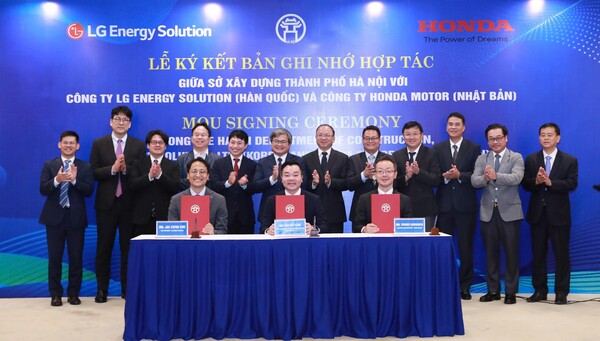
LG Energy Solution will work with Honda and the city of Hanoi in Vietnam to build battery swapping infrastructure for electric two-wheelers. LG Energy Solution said it signed an MOU on May 19 (local time) with Honda and Hanoi on cooperation to build public battery swapping stations (BSS) for electric two-wheelers. The three parties agreed to continue cooperation to build an ecosystem, including installing battery swapping stations in central Hanoi, developing battery standardisation and a safety management system, and jointly developing a business model for an electric two-wheeler platform.
From the third quarter of this year, the three parties plan to build about 50 battery swapping stations in key areas of Hanoi and begin a pilot project by introducing 500 electric two-wheelers.
The batteries will use LG Energy Solution's cylindrical 2170 cells. LG Energy Solution will handle building a safety management system, operating the swapping system, supporting operating solutions and managing the battery life cycle, in addition to supplying batteries. Honda will be responsible for battery packs (MPP), swapping equipment and electric two-wheelers. According to the Vietnam Association of Motorcycle Manufacturers (VAMM), Honda's share of Vietnam's motorcycle market reached 86 percent in 2025. Hanoi will handle permits, policy support and cooperation on local operations.
Hanoi, Vietnam's capital, has a population of about 8.5 million and more than 6 million registered motorcycles, showing high reliance on two-wheelers. Air pollution has been a chronic social problem, and Hanoi last year announced a policy to restrict the operation of internal combustion engine motorcycles in the city centre. The plan calls for restrictions by time and zone starting in July this year and a phased expansion through 2030.
According to Vietnam's National Traffic Safety Committee, Vietnam's two-wheeler market totals about 80 million vehicles as of 2025, and electric two-wheelers account for only about 4 percent, or 3.2 million. RMIT University in Melbourne, Australia, analysed that Vietnam's electric two-wheeler market will grow by more than 18 percent a year on average in the coming years.
Truong Viet Dung (쯔엉 비엣 중), a vice chairman of Hanoi, said South Korea and Japan are countries leading the field of battery swapping stations for electric two-wheelers. He said he hopes that, based on the technological capabilities of LG Energy Solution and Honda, battery swapping infrastructure for electric two-wheelers will be built so Hanoi residents can use it more conveniently.
An LG Energy Solution official said Vietnam is the most critical country in Southeast Asia for the transition to electric two-wheelers. The official said the company will continue to contribute to building Vietnam's eco-friendly transport infrastructure based on differentiated technology that is safe and dramatically increases usage time and lifespan in the two-wheeler battery field.
 Dae-geon Seok
d2dg@d-today.co.kr
Dae-geon Seok
d2dg@d-today.co.kr