
Intel's high-performance desktop processor, the Intel Core i9-14900KF, set a new world record CPU frequency at 9.206 GHz. The record was achieved in an extreme overclocking environment, and some assess it as pushing up the performance limits of consumer CPUs again.
On May 18, online media outlet Gigazine reported that the record was set by Chinese overclocker wytiwx. The measurement was confirmed through CPU-Z, a system information and benchmark program, and the information was also registered in the CPU-Z Validator database.
Overclocking is a way to draw out maximum performance by running a CPU or GPU above the base operating speed set by the manufacturer. To push the single-core performance of the Intel Core i9-14900KF to the extreme, wytiwx enabled only 1 P-core and ran the test with power limits fully removed.
The actual recorded clock speed was 9,206.34 MHz. It surpassed the previous highest record for a consumer CPU. The Intel Core i9-13900K previously broke the 9 GHz barrier for the first time, but this time a next-generation processor pushed the record higher.
The system configuration used to achieve the record was also disclosed. The motherboard was an Asus ROG Maximus Z790 Apex, and the thermal paste was Thermal Grizzly's Kryonaut Extreme. The memory was 16GB DDR5 SDRAM, and the power supply was an Asus ROG Thor Gaming 1,600W unit.
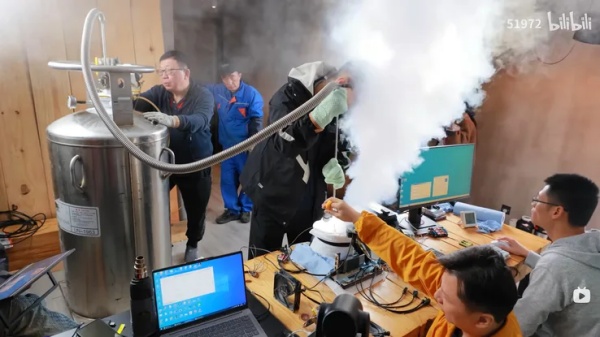
The most striking part was the cooling method. The system was brought to ultralow temperatures by injecting liquid helium, drawing out performance limits that are hard to reach with typical cooling systems. It underscored that the record is less a performance metric aimed at everyday consumer environments than a test of a chip's maximum frequency potential.
The record is far from settings usable in everyday consumer environments. With only a single P-core enabled, power limits removed and liquid helium cooling brought in, it is effectively difficult for ordinary users to reproduce. Still, the result is assessed as an example showing how much overclocking headroom Intel's latest high-performance desktop chip has under extreme conditions.
The industry views the record as a symbolic case that goes beyond a simple numbers competition and tests the limits of the latest CPU designs and power and heat control technologies.
 Jinju Hong
hongjj@d-today.co.kr
Jinju Hong
hongjj@d-today.co.kr