
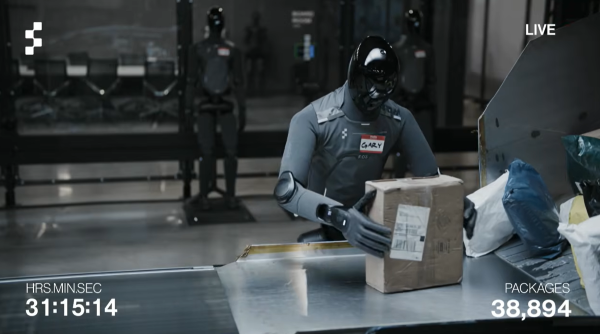
In a public test comparing productivity between a humanoid robot and a human worker, a human intern narrowly beat the robot. Some also said the robot has greater potential when factoring in accumulated work hours and the ability to operate without breaks.
On May 18 local time, blockchain media outlet BeInCrypto reported that humanoid robot F.03 developed by robotics startup Figure AI and a human intern, Aime, competed by performing the same parcel-sorting work for 10 hours. The task repeated the same motions: scanning a barcode, picking up a package and placing it on a conveyor belt with the barcode facing down.
The final result was a win for the human intern. Aime processed 12,924 packages, beating F.03, which logged 12,732, by 192. Average processing speed was 2.79 seconds per package for the human and 2.83 seconds for the robot, a difference of about 0.04 seconds.
At times during the contest, the robot led the human. While Aime stepped away to take breaks, including bathroom time and legally mandated breaks, F.03 briefly moved into first place, but the human later widened the gap and took the final win.
After the contest, Aime complained of finger blisters along with pain in the left arm and lower back and said, "If I had done 30 more minutes, I would have quit." F.03, by contrast, can operate continuously without shift changes, and some pointed out it is difficult to fully compare long-hour, multi-shift conditions using only single-shift performance.
Figure AI Chief Executive Brett Adcock (브렛 애드콕) congratulated the human intern on the result but mentioned, "This will be the last time a human wins." He stressed that because robots can be deployed for long continuous periods without rest, they could hold an advantage in a long-term productivity competition.
The test has also been seen as showing that robots in physical labor have reached near parity with humans, while still revealing that humans retain a slight edge on a single-shift basis.
In the same article, Microsoft AI group CEO Mustafa Suleyman (무스타파 슐레이만) forecast that the pace of office-work automation could move much faster. Mentioning jobs such as lawyers, accountants, project managers and marketing, he said, "A significant portion of computer-based work can be automated by AI within the next 12 to 18 months."
Overall, the test suggests that robots' physical task performance has reached a level close to humans, but that the gap between long-hour continuous operation and the pace of office-work AI automation could be a key variable in future labor-market change.
Congrats to Aime!! He said his left forearm is basically broken Final scores: → F.03: 12,732 packages (2.83 seconds/package) → Aime: 12,924 packages (2.79 seconds/package) This is the last time a human will ever win pic.twitter.com/CalDzPZz4d
 Jinju Hong
hongjj@d-today.co.kr
Jinju Hong
hongjj@d-today.co.kr