
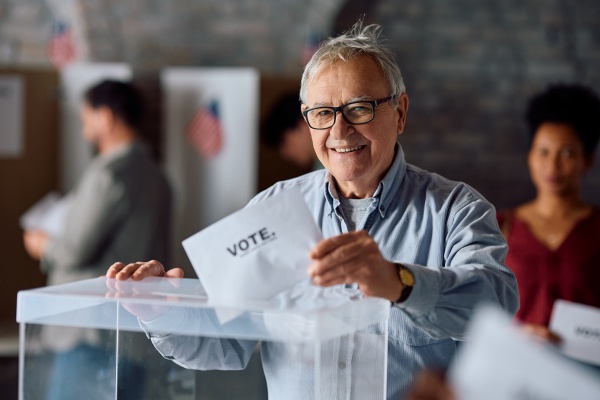
A long-term U.S. follow-up study found older adults who took part in elections had a lower long-term risk of death than those who did not.
Online media outlet Gigazine reported on Friday that a research team led by associate professor Sarah Konrath at Indiana University analysed data from the Wisconsin Longitudinal Study and found that older adults who voted in the 2008 U.S. presidential election were less likely to die 5, 10 and 15 years after voting than nonvoters.
The team examined whether civic participation such as voting, as well as health habits such as diet and exercise, could be linked to longevity. The analysis used the Wisconsin Longitudinal Study, which has randomly followed Wisconsin high school graduates since 1957. Voting was confirmed using Catalist, a U.S. voter behaviour database, and deaths were verified through an official death-record index.
The key figures were clearest in the 2008 presidential election. Older adults who voted were 45 percent less likely to die within 5 years than those who did not vote, 37 percent less likely within 10 years and 29 percent less likely within 15 years. The researchers also looked at the 2004 and 2012 presidential elections and said similar effects were confirmed in both. The trend was stronger in the 2008 and 2012 elections than in 2004.
A key issue was the interpretation that healthier people may be more likely to vote in the first place. The team analysed the results while also reflecting pre-election health status as well as sex, marital status, income, volunteering and participation in other civic activities. It found that even after accounting for those factors, the voting group still had a lower risk of death. The improvement in mortality at the 15-year mark after voting was larger among people who had been in poorer health before voting.
The voting method did not make a difference. The team said that when it compared older adults who went to polling stations with those who voted by mail, both groups showed a similarly lower level of mortality over 15 years. It also confirmed that there was no relationship between voting method and mortality.
The election outcome itself also did not act as a variable. No meaningful association was found between whether a supported candidate won or lost and subsequent mortality. Regardless of political orientation, older adults showed a pattern in which participation in voting itself was linked to lower long-term mortality risk.
The researchers pointed to the psychological and social effects of civic participation as a possible background factor. Prior research has accumulated evidence that volunteering can stimulate the brain's reward system, reduce stress and slow some ageing processes. The team said voting could also be an 'altruistic and community-oriented behaviour' and may have positive health effects by boosting self-efficacy and a sense of social connection.
The results do not conclude that voting directly extends lifespan. The findings are meaningful in that they add evidence showing how civic participation by older adults may be connected to health indicators and long-term survival. The team said follow-up research is likely to continue, including on how to expand social participation among older adults and whether improving accessibility, including mail voting, is linked to health.
 Jinju Hong
hongjj@d-today.co.kr
Jinju Hong
hongjj@d-today.co.kr