
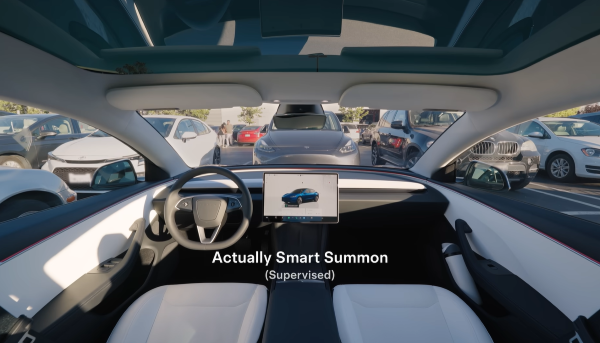
[DigitalToday intern reporter Seung-a Yoo] Tesla has rolled out its Full Self-Driving (FSD) software, FSD V14.3.3, raising the top speed of “Actually Smart Summon” to 8 mph from 6 mph. On May 17 (local time), electric vehicle outlet Electrek reported that the change makes the feature 33 percent faster.
Actually Smart Summon allows a vehicle to come directly to its owner’s location in a parking lot, or move on its own to a point designated on a map. Tesla introduced it in September 2024, but criticism has persisted that the low speed reduced its practical usefulness. In crowded commercial parking lots, following vehicles often backed up, and users had to watch the car in the app and be ready to stop it at any time.
The update raises the speed limit to 8 mph, or about 13 km per hour. The difference is only 2 mph on paper, but the effect is substantial. Based on a 200-foot, or about 61-metre, parking lot, a trip that previously took about 23 seconds is cut to about 17 seconds at the new limit.
Tesla cites a structural overhaul of the FSD V14.3 line as the backdrop to the speed increase. In V14.3, it rebuilt its artificial intelligence compiler on a full Multi-Level Intermediate Representation (Multi-Level IR, MLIR) basis, boosting response speed by 20 percent. In V14.3.2, it unified consumer FSD, commercial robotaxis and the summon function into a single architecture.
As a result, the parking-lot summon function now uses the same neural network as highway driving. Tesla said the unified model improves the speed of recognizing the surrounding environment and also improves responses to obstacles, pedestrians and vehicles. The speed increase is the first visible result.
Still, it is limited to AI4, vehicles equipped with the Hardware 4 (HW4) computing platform. Because Tesla runs V14 centered on AI4, HW3 vehicle owners are unlikely to see the same speed increase. Tesla has recently promised to provide “V14 Lite” for HW3 vehicles in overseas markets, but that update is expected to take several more months.
Regulatory pressure has also eased somewhat. The U.S. National Highway Traffic Safety Administration (NHTSA) reviewed 159 reports related to Actually Smart Summon and closed its investigation about 6 weeks ago. Across the full usage history, there were no injuries, and accidents were limited to minor property damage involving parking barriers, adjacent vehicles and bollards. Tesla improved issues through six over-the-air (OTA) updates during the probe, and NHTSA concluded the measures were sufficient and ended the investigation without a recall.
The rollout also includes additional features. A new counter on the main display shows in real time the distance driven continuously by FSD without driver intervention, and the figure resets to 0 the moment the driver takes control. The feedback menu that appears when FSD is forcibly disengaged was also simplified to navigation, parking, critical and other from the previous options of preferred, inconvenient, critical and navigation.
The update clearly shows a push to unify FSD software under a single structure alongside speed improvements. But by applying the speed increase only to AI4 vehicles, the gap has grown more pronounced for owners using older hardware even if they purchased FSD.
 Seung-a Yoo
ysah@d-today.co.kr
Seung-a Yoo
ysah@d-today.co.kr