
As the stock market mood heats up, with the KOSPI topping 8,000 intraday, debate is resurfacing over reviving the financial investment income tax.
The tax is a system that pools income from financial investments such as stocks, bonds, funds and derivatives, and levies tax on gains above a certain amount.
It was designed to tax domestic stock and other financial investment income when it exceeds 50 million won, and other financial investment income when it exceeds 2.5 million won. The tax rate is around 22 to 27.5 percent depending on the taxable income bracket.
After its introduction was decided in 2020, implementation was postponed. It was abolished in December 2024 when the National Assembly passed an amendment to the Income Tax Act amid resistance from individual investors and worries it could dampen the stock market.
At the time, a weak KOSPI and worsening investor sentiment bolstered calls for abolition. But as the KOSPI rose past 6,000 and 7,000 to 8,000, claims are resurfacing that "market conditions have changed."
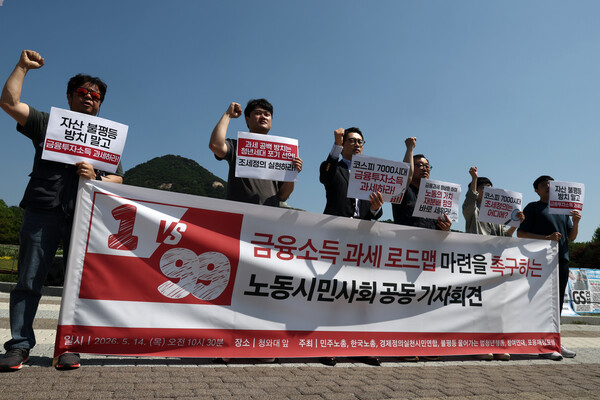
Labour and civic groups say normalising taxation of financial income is necessary. The Korean Confederation of Trade Unions, the Federation of Korean Trade Unions and the People's Solidarity for Participatory Democracy held a news conference on May 14 in front of the fountain at Cheong Wa Dae in Seoul's Jongno district and urged the government to draw up a "roadmap to normalise financial taxation."
They criticised the fact that debate on taxing financial income has stalled even as the stock market rally continues, with the KOSPI nearing 8,000.
They also took issue with the fact that taxation on capital gains from domestic stocks is effectively not implemented. They said wage income is taxed relatively closely, while capital income taxation is not sufficient. With a stock market rise potentially widening the asset gap, they argued the principle of taxing financial investment income should be re-established.
Fuel was added to renewed debate by remarks from President Lee Jae-myung (이재명). Lee mentioned on April 9 at the National Economic Advisory Council the need to reform the system for the securities transaction tax and the capital gains tax. Pointing to the regressive nature of a transaction tax imposed regardless of losses, he spoke to the effect that those who make money should pay and those who do not should not pay.
At present, many individual investors do not pay a separate capital gains tax even if they profit from trading domestic stocks. By contrast, the securities transaction tax is levied when shares are sold, regardless of whether there is a profit.
Supporters of the financial investment income tax see this structure as inconsistent with tax fairness. Opponents, on the other hand, worry the tax could lead to money leaving the domestic stock market and a hit to investor sentiment.
There is also strong pushback in politics. Song Eon-seok (송언석), floor leader of the People Power Party, criticised at a party meeting on April 28 that anxiety is spreading that the Lee Jae-myung government will abruptly revive the tax as part of a "tax bomb" to be fully launched after the June 3 local elections.
He argued that revisiting it in just over a year could damage policy consistency and trust in the government, noting that it was abolished in 2024 by bipartisan agreement.
Investor backlash is also a variable. With participation in stock investing rising sharply, sensitivity has also increased to stock market tax systems and policy remarks. According to the Korea Securities Depository, 14.56 million investors held shares of listed companies last year. The number of active stock trading accounts stood at 105.22 million on May 4, up 6.93 million from the end of last year, based on the Korea Financial Investment Association.
As individual investors increase, cases are also becoming more frequent in which remarks by the government and politicians are directly linked to stock market sentiment. With the recent spread of a stock investing boom, a phenomenon has also emerged in which individual investors take policy remarks and even civic group discussions as variables for share prices. That is why debate over the tax goes beyond a simple tax overhaul and is directly tied to investor sentiment.
The government is not officially moving to reintroduce the tax immediately. Deputy Prime Minister Gu Yun-cheol (구윤철), who is also minister of economy and finance, said at a press briefing on May 11, regarding the tax, that it is "a task to be reviewed at a point when market conditions are sufficiently in place, such as the state of the capital market." The Democratic Party also says it has nothing it is officially discussing immediately.
Markets see a strong chance the debate will repeatedly flare up during a stock market upswing. While claims are gaining strength that room for taxation has increased as the KOSPI moves above 8,000, it is also hard to ignore increased volatility after a short-term surge and investor backlash.
In fact, on May 15 the KOSPI broke above 8,000 intraday and then saw increased volatility as profit-taking and worries over policy uncertainty overlapped.
A financial investment industry official said, "Debate over the financial investment income tax is a topic that is hard to avoid from the perspective of tax fairness, but in a situation where the market has surged in a short period, investors can react sensitively even to small policy signals." The official added, "If a tax overhaul is needed, there needs to be a way to reduce the market shock by discussing together transaction tax adjustments, profit and loss netting, loss carryforwards and incentives for long-term investment."
 Sangyeob Oh
yub@d-today.co.kr
Sangyeob Oh
yub@d-today.co.kr