
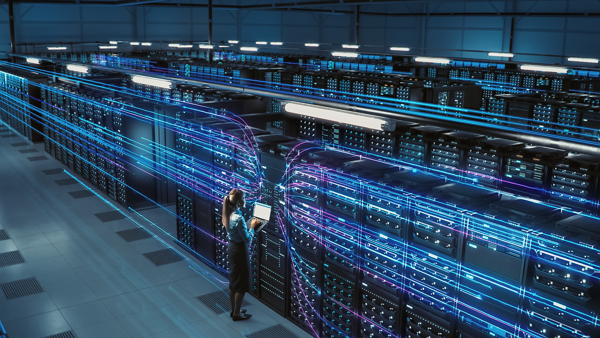
Expectations are spreading across the power equipment value chain ahead of the July shipments of Nvidia's next-generation AI accelerator Rubin. A rack built with Rubin requires about 1.5 times more power than the current Blackwell and about 5 times more than the previous Hopper. If Rubin enters mass production on schedule, demand for key parts of transmission and distribution networks such as transformers and cables is expected to jump another step, analysts say.
According to Kyobo Securities, a Blackwell rack requires about 3.3 times more power than a rack built with the Hopper series. A rack built with the Rubin series to be launched this year requires about 1.5 times more power again. Performance per unit of power has improved, but the shift into an inference-scaling phase such as agentic AI has raised the need for computing power further.
Demand is also strong. Hyperscalers' estimates for 12-month forward capital expenditures have recently been revised up by about 6.2 percent. In Google's case, this year's revenue estimate for Google Cloud, an AI-related business unit, is seen rising 6.3 percent from a year earlier, with an operating margin around 30.7 percent, creating a cycle in which AI investment is already feeding into profit.
This rise in power density translates into a surge in total data centre consumption. According to an International Energy Agency report, half of new electricity demand in the United States is for data centres, and it is expected to reach 12 percent of total electricity in 2028. Global data centre power consumption stood at about 416 terawatt-hours in 2024 and is expected to rise to 669 to 1,264 TWh in 2030.
TRANSFORMER LEAD TIMES AT 4 YEARS; SPILLOVER SPREADS AS LEADERS HIT SATURATION
Because the power equipment industry has an inelastic, labour-driven supply structure, it cannot easily increase supply even if demand rises. As a result, the average lead time for ultra-high-voltage transformers, one of the key power devices, has expanded sharply to about 4 years from a past level of 1 to 2 years. Upgrading ageing power grids alone can improve power efficiency by about 20 percent, meaning a dual boom is unfolding at the same time in new power-source growth and replacement demand for ageing equipment.
Order backlogs at the leading companies are already saturated. The combined order backlog of South Korea's three heavy electric equipment companies - HD Hyundai Electric, Hyosung Heavy Industries and LS Electric - was about three times higher by the end of 2025 than in 2022, before AI-related demand emerged, while operating profit rose more than fivefold. Average trading value over the past 2 years jumped about 237.8 percent from the average of the previous 3 years, and average market capitalisation also rose about sixfold, establishing the trend as a market leader.
In this situation, Kyobo Securities analysed that supply shortages at the leading companies act as an opportunity factor for laggards. As lead time delays at large global power equipment makers accelerate demand to diversify supply chains, orders spread to verified small and mid-sized companies, the logic goes. Hanwha Vision, Sanil Electric, Iljin Electric and ISC have previously shown a trend of narrowing valuation gaps.
A variable is speculation of delays to the Rubin launch. TrendForce, a market research firm, said in April that shipment timing could be delayed due to technical tasks such as HBM4 verification, network chip changes, power consumption management and performance optimisation in liquid-cooling environments. U.S. investment bank KeyBanc also analysed that Nvidia appears to have lowered its production target for Rubin this year to 1.5 million units from 2 million. Still, the July shipment schedule itself is holding, and the prevailing view is that a jump in power demand as mass production ramps up is only a matter of time.
The key is the mass production schedule. If Rubin ships on the July timetable, the jump in power density is likely to spread quickly across the transmission and distribution network, including transformers, cables and distribution equipment. An industry official said, "Even if some delays occur, the rising share of Blackwell means the trend of increasing power demand itself will not be shaken."
 Daegeon Seok
d2dg@d-today.co.kr
Daegeon Seok
d2dg@d-today.co.kr