
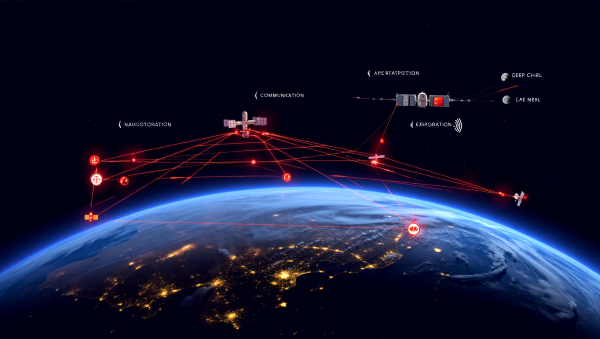
Big Tech companies are speeding up efforts to turn ambitious ideas into reality by using space satellites to harness solar energy for AI computing needed on Earth.
Elon Musk has reshaped SpaceX's future strategy around operating AI data centres in space, and Blue Origin, led by Amazon founder Jeff Bezos, is also emphasising the same vision. Google and Planet Labs are testing how satellites can run AI computing systems.
Google has begun talks with SpaceX and others to push 'Project SunCatcher' to build data centres in space. Google is reviewing a plan to build a solar-powered satellite network equipped with its own tensor processing units, or TPUs, to create what it calls an 'orbital AI cloud'.
Nvidia recently posted a job opening for a role that sounds futuristic: 'space orbital data centre system architect'.
A scenario that shifts AI computing tasks to orbit appears to be drawing more attention as AI spreads and demand for related infrastructure surges.
AI developers could scale up AI without being constrained by obstacles on Earth such as attempts to ban data centres, but turning the ambitious scenario into reality is still not easy.
The Wall Street Journal recently reported that operating data centres in orbit would require technical advances across a range of fields, from handling radiation to rocket technology. One of the biggest challenges is mass-producing and launching this equipment without incurring huge costs. Some engineers see it as uneconomic, and many questions remain unanswered, the WSJ reported.
Running AI data centres in space would require building satellites loaded with large numbers of AI chips. They would also need solar panels to generate electricity to run AI computing systems. These satellites are likely to fly in orbits that pass above Earth's polar regions to maximise exposure to sunlight, the WSJ reported.
Satellites have operated using solar power for decades. Building satellites for AI would require scaling that technology up to a much larger level. One estimate says the International Space Station generates only enough power to run about 100 advanced AI chips, but space data centres may need to generate enough electricity to power thousands to tens of thousands of chips installed across many satellites, the WSJ reported.
Super-sized solar arrays are drawing attention in this context. Rocket Lab Chief Executive Peter Beck told investors earlier this year, "We need solar arrays on the scale of several kilometres."
Even if securing solar energy is solved, managing heat remains a major challenge. Space is cold and a vacuum. AI satellites therefore need advanced systems to control temperature so AI chips can run continuously. Keeping satellites cool while AI chips emit heat is a major obstacle to bringing the cost competitiveness of space data centres in line with ground-based infrastructure, the WSJ reported.
AI satellites will use radiators to remove heat generated by chips, but larger radiators and equipment that supports heat dissipation would increase satellite weight. Large radiators may also be more prone to failure and could raise costs, the WSJ reported, citing space technology consultant Santani Rao.
According to Japan's ITmedia, contrary to the perception that space is cold, cooling high-heat computing equipment in a vacuum can be harder because ways to release heat outward are limited. The core of space data centres is not that space is cold, but how heat is handled. On Earth, heat is released using air and water, but space is a high vacuum, making conduction and convection unusable and forcing reliance on radiation. For that reason, the low external temperature alone does not lower the barriers to entry for cooling, it said.
Reliably transmitting data between AI satellites, and between space and Earth, is another area that requires high-level engineering. Optical links, known as 'space lasers', can be used to transmit data between satellites, but they require huge amounts of energy, and sending more data requires more energy, the WSJ reported.
In addition, sending data in space requires precisely controlling the direction of laser devices mounted on satellites, and that would be very difficult given the scale of space data centres, it said. Communicating with Earth is another issue. The WSJ cited Daniel Bliss, a professor of engineering at Arizona State University, as saying, "Many space data centre concepts currently being proposed assume using radio frequency (RF) to send data to the ground, but there are limits to the amount of data the RF band can transmit."
 Chi-gyu Hwang
delight@d-today.co.kr
Chi-gyu Hwang
delight@d-today.co.kr