
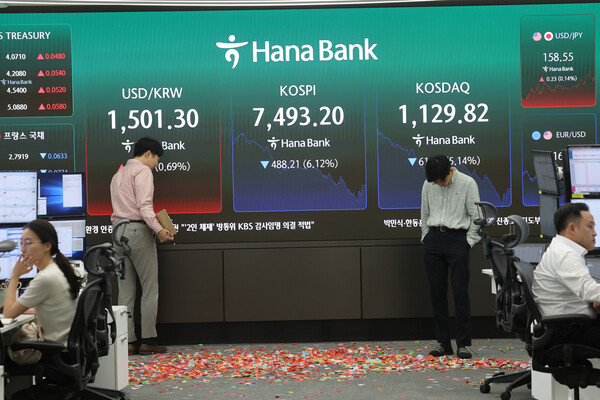
[DigitalToday reporter Sangyeop Oh] The KOSPI broke above 8,000 intraday for the first time ever but closed sharply lower as foreign investors and institutions sold. With the burden of a short-term surge growing, worries over higher U.S. rates, geopolitical uncertainty and foreign outflows combined to trigger an intraday program trading curb on the sell side.
On May 15, the KOSPI closed down 488.23 points, or 6.12 percent, from the previous session at 7,493.18. The Kosdaq also ended down 5.14 percent at 1,129.82.
The KOSPI first crossed 8,000 in early trading. It broke above 8,000 at 9:13 a.m. and rose as high as 8,046 during the session, but later turned lower as selling emerged.
Losses widened in the afternoon, and at 1:28:49 p.m. a program trading curb known as a sidecar was triggered in the KOSPI market. With the KOSPI200 futures index down more than 5 percent from the previous session for 1 minute, the validity of program sell orders was suspended for 5 minutes.
Supply and demand pressure was heavy. In the main board market, foreigners posted net sales of about 5.6 trillion won and institutions sold about 1.7 trillion won net. Retail investors posted net buying of about 7.2 trillion won and absorbed supply, but it was not enough to stop the index from falling. Foreigners extended net selling for a seventh straight session since May 7.
Most large-cap stocks with the biggest market capitalisation also weakened. Samsung Electronics and SK Hynix had been key stocks leading the index higher in May, but were at the centre of profit-taking selling on the day. Some robot-related stocks, including Doosan Robotics and LG Electronics, extended gains.
In the securities industry, the sharp drop was seen as profit-taking after short-term overheating. The KOSPI surged in a short period, increasing technical 부담, and concentration in semiconductors also deepened, it said.
External factors also weighed. U.S. consumer and producer prices exceeded expectations, pushing market rates higher, and the U.S. 10-year Treasury yield topped 4.5 percent. Concerns about a Bank of Japan rate hike following a rise in Japan's corporate goods price index also weighed on investor sentiment.
In addition, reports of tough comments by U.S. President Donald Trump on Iran pushed U.S. stock index futures into negative territory and deepened losses in domestic stocks.
The market had limited additional positive catalysts after the U.S.-China summit, which also had an impact. Expectations that were priced in ahead of the summit were partly exhausted, and short-term momentum weakened as earnings announcements by major domestic companies moved into a wrapping-up phase, according to an analysis.
Still, the securities industry also said it was difficult to immediately view the day's pullback as a trend reversal. Semiconductor profit 전망 continues to support the index, and foreign selling largely reflects portfolio adjustments in large caps that have surged, it said.
Jin-hyuk Kang (강진혁), an analyst at Shinhan Investment Corp, said, "The concentration driven by semiconductor earnings estimates is not a major concern, but it means it can stimulate profit-taking appetite and react sensitively to negative factors." He said, "The emergence of uncomfortable factors such as geopolitics and interest rates means the decline on the day may not be a one-off."
 Sangyeop Oh
yub@d-today.co.kr
Sangyeop Oh
yub@d-today.co.kr