
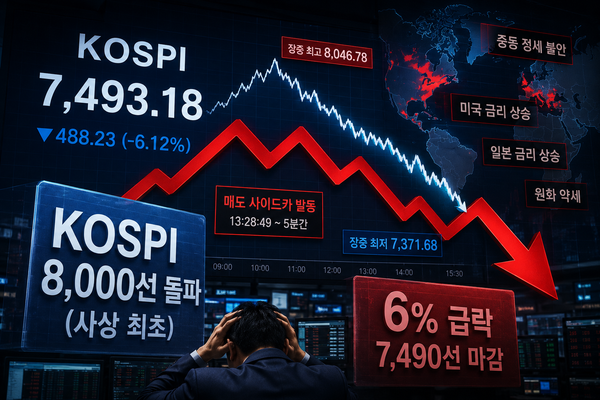
South Korea's KOSPI on Thursday broke above the 8,000 mark for the first time during the session before turning sharply lower and closing below 7,500. Profit-taking pressure grew after a short-term surge, while Middle East tensions, rising U.S. and Japanese interest rates and a weaker won combined to quickly dampen investor sentiment.
The KOSPI ended down 488.23 points, or 6.12 percent, at 7,493.18. The index opened down 29.66 points, or 0.37 percent, at 7,951.75, then turned higher early in the session and rose as far as 8,046.78.
That put the KOSPI above 8,000 just 7 trading sessions after it first crossed 7,000 on May 6. It later turned lower as profit-taking selling poured out, sliding as far as 7,371.68 before trimming some of the loss.
The Korea Exchange said the 488.23-point drop based on the close was the second-largest on record. The biggest decline was 698.37 points recorded on March 4. The gap between the intraday high and low reached 675.10 points.
A so-called sell sidecar, a temporary halt of program sell orders, was triggered during the plunge. The Korea Exchange halted program sell orders for 5 minutes at about 1:28:49 p.m. due to swings in KOSPI200 futures. At the time of activation, the KOSPI200 futures index was down 63.50 points, or 5.09 percent, from the previous close at 1,182.00.
A KOSPI sell sidecar is triggered when the KOSPI200 futures index falls 5 percent or more for 1 minute. It marked the first activation of a KOSPI sell sidecar since April 2, about a month earlier.
By investor type, retail investors made large purchases but could not offset foreign and institutional selling. Retail investors were net buyers of 7.2287 trillion won. Foreign investors and institutions were net sellers of 5.6043 trillion won and 1.7332 trillion won, respectively.
In Seoul's foreign exchange market, the won rose to 1,500.30 per dollar, adding to the burden on foreign investor flows and also weighing on the index.
With the KOSPI having surged 20.9 percent since May through the previous day, perceptions of short-term overheating also appeared to encourage profit-taking.
Most of the top market-cap stocks weakened. Samsung Electronics fell 8.61 percent to 270,500 won and SK Hynix dropped 7.66 percent to 1,819,000 won.
SK Square fell 6.23 percent, LG Energy Solution lost 5.66 percent, Doosan Enerbility slid 5.38 percent, HD Hyundai Heavy Industries fell 4.62 percent and Samsung Biologics dropped 2.07 percent. Hyundai Motor and Samsung Electro-Mechanics fell 1.69 percent and 1.37 percent, respectively.
KOSDAQ also fell sharply. The KOSDAQ ended down 61.27 points, or 5.14 percent, at 1,129.82.
Han Ji-young (한지영), an analyst at Kiwoom Securities, cited as factors behind the plunge uncertainty related to U.S.-Iran negotiations after expectations for a U.S.-China summit faded, the U.S. 10-year Treasury yield breaking above the 4.5 percent range, aftershocks from April U.S. CPI and PPI surprises, rising rates in Japan due to inflation pressure, a sharp jump in the dollar-won exchange rate and speed concerns after a short-term rally.
Han also pointed to the fact that it took only 8 trading sessions for the KOSPI to rise from 7,000 to 8,000, and that gains were concentrated in some sectors including semiconductors and autos. The analysis said rising rates and geopolitical uncertainty served as justification for the market to moderate its pace.
 Sang-yeop Oh
yub@d-today.co.kr
Sang-yeop Oh
yub@d-today.co.kr