
[DigitalToday Kyung-min Hong] Tesla has started extensive testing to secure real-world driving data by deploying its autonomous robotaxi Cybercab across major U.S. cities and outlying areas.
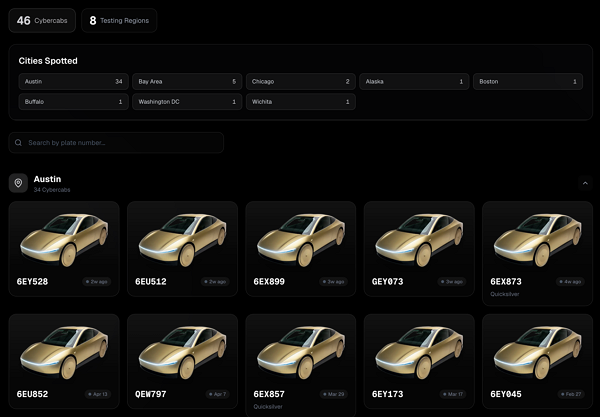
On May 14 (local time), electric vehicle outlet CleanTechnica reported that Tesla's new autonomous vehicle, tracked via "Cybercab Tracker", has been spotted in places with sharply different geographic characteristics, including Austin, Texas, Alaska and Wichita, Kansas.
The deployment identified so far shows the largest concentration in Austin, where Tesla's headquarters is located, with 34 vehicles. There are 5 in the San Francisco Bay Area and 2 in Chicago. Single vehicles were also confirmed to have moved to major hubs including Washington, Buffalo and Boston, showing Tesla is trying to build a nationwide driving network.
The deployment is drawing industry attention because it is an unusual geographic dispersal at a time when initial production volumes are very small. Experts are analyzing it as an effort to verify Full Self-Driving (FSD) capabilities in varied weather and road conditions before Tesla unveils the Cybercab to the public.
Including not only large cities such as Chicago and Boston but also extreme regions such as Alaska in the test scope is seen as a data collection process to implement robotaxi-level service that works in any environment.
The most striking point is sightings in areas unfamiliar as typical autonomous driving test sites, such as Alaska and Wichita. For Alaska, the logic holds that it is a suitable place to test special driving scenarios such as severe cold and snowy roads. But various speculations are circulating about why the company sent vehicles to places such as Wichita. This can be interpreted as evidence that Tesla is trying to train the system on both ordinary and unique road situations across the United States, rather than limiting it to specific large cities.
This move by Tesla is widely viewed as an essential procedure given that the Cybercab is a completely new model with almost no driving track record. It is a strategy to send low-volume production vehicles nationwide to secure stability on real roads before full-scale robotaxi commercialization.
Still, the market remains cautious about whether the data collected this way can raise autonomous driving completeness to a level that enables robotaxi service in the short term.
Ultimately, Tesla appears to be testing the Cybercab's commercialization potential through nationwide real-time monitoring and driving tests. As operating data accumulates from the vehicles that have been spotted, it is expected to become clearer whether Tesla's vision of a steering wheel-less robotaxi era will be realized.
 Kyung-min Hong (홍경민)
hongm@d-today.co.kr
Kyung-min Hong (홍경민)
hongm@d-today.co.kr