
[DigitalToday reporter Oh Sang-yup (오상엽)] The Financial Services Commission is speeding up detailed system design for issuance, distribution and settlement ahead of the introduction of a tokenised securities regime.
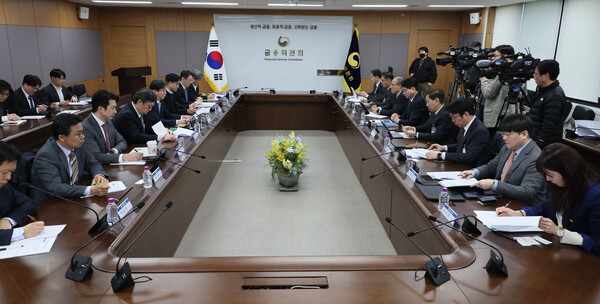
The commission said on Thursday it held the second meeting of a public-private "Token Securities Council" to discuss the direction of system design for tokenised securities issuance, distribution and related infrastructure.
The council was launched in March to prepare detailed measures on technology and infrastructure, issuance, distribution and settlement ahead of the enforcement of legislation to institutionalise tokenised securities next year. The government, related agencies and private-sector experts are participating.
At the meeting, participants reviewed issues related to revisions to subordinate regulations and guidelines the FSC is preparing, targeting an announcement in July, for the legislation to institutionalise tokenised securities.
On issuance of fractional investment securities, participants discussed eligibility of underlying assets and the direction of support for innovation. Various attempts are currently being made for fractional investment under the electronic securities method, and there are expectations it could become more active when combined with the tokenised securities regime.
The council also discussed issuance of fractional investment securities using a bundled underlying-asset method that is currently banned. Participants agreed it needs to be allowed within a certain scope, such as assets of the same type.
Expanding eligible assets for tokenisation and preparing infrastructure were also key agenda items. As global attempts to tokenise not only new types of securities such as fractional investment but also conventional standardised securities such as stocks and bonds are spreading, the government decided to speed up related preparations.
To prevent conflicts with existing systems and infrastructure, it plans to draw up a detailed step-by-step roadmap rather than switching all systems at once.
Based on this, the government and related agencies plan to prepare tests and infrastructure improvements for innovation across all stages of securities rights, trading and settlement, including on-chain settlement.
Participants also exchanged views on the market structure of an over-the-counter exchange for tokenised securities. The council discussed licensing requirements for the OTC exchange, the scope of allowing concurrent business operations and investor trading limits.
They agreed on the basic direction that the market structure should be designed to raise trading efficiency while enabling fair competition and investor protection, and decided to discuss details further.
On trading limits for general investors at the OTC exchange, which are delegated to the enforcement decree under the tokenised securities bill, participants also said they need to be set in a way that does not excessively constrain early market formation.
Kwon Dae-young (권대영), vice chairman of the Financial Services Commission, said the government's basic position is to design a market structure for tokenised securities OTC exchanges that improves trading efficiency while ensuring fair competition and investor protection.
He added that trading limits will be set to systematise investor protection while expanding initial market liquidity so they do not become a fence that traps innovation.
Kwon also said that market order and investor protection are fundamental premises of the capital market that must be maintained, but added that the government will not take a regulation-only approach and will support innovative attempts by fintech and the financial investment industry within a reasonable range.
Tokenised securities are digital securities that are issued and managed using a blockchain-based distributed ledger. They qualify as securities under the Capital Markets Act.
Amendments to the Electronic Securities Act and the Capital Markets Act, passed by the National Assembly in January as legislation to institutionalise tokenised securities, are expected to take effect on Feb. 4, 2027, after subordinate regulations are revised and infrastructure is built.
 Oh Sang-yup
yub@d-today.co.kr
Oh Sang-yup
yub@d-today.co.kr