
The Broadcasting Media Communication Commission and the Korea Information Society Development Institute on Thursday released the results of the 2025 assessment of competition in the broadcasting market. The report used compiled data from broadcasters' 2024 financial status disclosures, accounting reports and a survey on the broadcasting industry.
The assessment is conducted annually under the Broadcasting Act. It analyses four markets: the pay-TV market, the broadcasting channel trading market, the broadcasting video content trading market and the broadcasting advertising market.
Total revenue for broadcasters last year recorded negative growth for the second consecutive year. Pay-TV subscribers totalled 36.30 million in 2024, up 0.04 percent from a year earlier. Revenue rose 0.1 percent to 72.361 trillion won, with growth remaining stagnant. The combined share of subscribers for affiliates of the three internet protocol television (IPTV) companies rose to 87.2 percent, while their share of revenue expanded to 91.7 percent. The commission judged it unlikely that deeper market concentration would lead to higher fees as competitive pressure from online video services (OTT) increases.
Total revenue from providing broadcast channels rose 4.6 percent from a year earlier to 15.629 trillion won, sustaining growth. Home shopping transmission fees came to 24.611 trillion won, up 0.2 percent, with growth slowing. It forecast that if the slump in the broadcasting advertising and pay-TV markets worsens, the likelihood of disputes over channel fees and commissions between pay-TV operators and broadcast channel operators would increase.
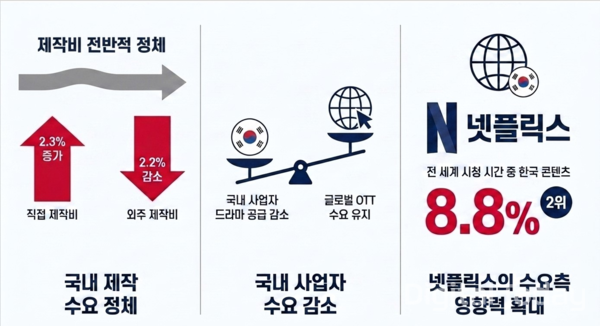
Domestic production demand stagnated, while Netflix's influence grew. Total direct production costs for broadcasters rose 2.3 percent from a year earlier to 29.709 trillion won. Outsourced production costs fell 2.2 percent to 987.8 billion won. The number of dramas supplied by broadcasters and OTT operators also fell to 108 from 112 a year earlier.
Broadcasters' outsourced production costs fell 2.2 percent to 987.8 billion won from 1.0101 trillion won a year earlier, dropping below 1 trillion won. That reflected broadcasters increasing in-house production while reducing orders placed with independent production companies. The number of dramas supplied also fell to 108 from 112 a year earlier.
Demand for drama production from domestic broadcasters and OTT operators fell, but demand from global OTT operators such as Netflix instead increased. Netflix's Korean original content remained at 30 titles in 2024, unchanged from a year earlier. Domestic OTT drama supply fell over the same period to 8 from 13.
The commission reported the assessment report to the National Assembly. It plans to release it on its website and on the Broadcasting Statistics Portal.
 Seulgi Son
sageson@d-today.co.kr
Seulgi Son
sageson@d-today.co.kr