
[Digital Today reporter Jinju Hong] A tiny open-source dashboard has emerged that shows real-time usage of Anthropic's AI coding tool Claude Code. In developer communities, some reactions say it is a symbolic example that AI coding tools are changing development culture itself, going beyond a simple hobby project.
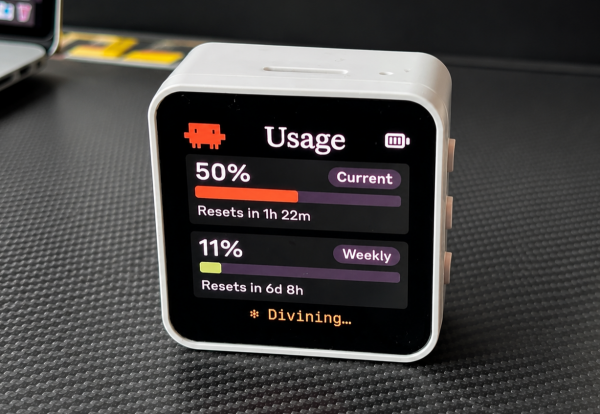
On May 14 local time, TechCrunch reported that Reykjavik-based software developer Hermann Haraldsson (헤르만 하랄드손) unveiled a small display device called ClaudeMeter.
ClaudeMeter is a device that displays per-session and weekly usage statistics for Claude Code on a separate screen. It connects to a laptop via Bluetooth, and when powered on it runs a pixel-art style character animation. As usage rises, movement on the screen becomes more active.
Users can press a central button to view usage data in the form of a simple chart instead of the animation. Touching the screen switches back to the initial animation screen.
ClaudeMeter is drawing attention less for its functions than as an example showing the recent mood in developer communities. TechCrunch reported that among some software engineers, a growing trend is to view AI token usage itself as a kind of indicator of productivity and how much it is being used.
Online reactions followed. One Reddit user joked, "At this point, Anthropic should be handing out the device for free," and another user suggested adding a button to top up tokens.
Haraldsson explained that he is not originally an embedded developer. He said Claude Code guided the project implementation process in just a few days, and that AI has made it much easier than before for non-experts to approach development work.
He said he spent the most time on design rather than functions during production. He put effort into adjusting fonts, colours and pixel animations, and described it as "like a small dopamine loop when you see the screen moving like crazy while working."
The device can be made using a small lithium-ion battery-powered display. The example cited by the outlet was Waveshare's ESP32-S3-Touch-AMOLED-2.16 device, which connects to a laptop via Bluetooth, and lets users check Bluetooth connection status and reset functions through button operations.
The two side buttons also link with Claude Code shortcuts. One button sends a space input for voice mode, and the other sends a shift+tab input, allowing switching between normal mode, edit accept mode, plan mode and auto mode.
The usage tally method is relatively simple. ClaudeMeter reads a Claude Code OAuth token, calls an API and then directly displays usage figures returned in response headers. It tracks current limit usage based on data returned by the actual service rather than an estimation method.
Its release as open source is also speeding up its spread. Anyone can fork the repository and freely modify the screen layout, animations and functions. Haraldsson said that in about 10 days after it was made public it recorded more than 800 GitHub stars and more than 50 forks.
Haraldsson said the appeal of the device is the feel of being a dedicated device. He said, "In the past, when listening to music there were dedicated devices for each purpose, like a Walkman or an iPod," adding, "It's a function you can implement enough inside a computer, but there's fun in seeing it on a separate device."
In the industry, ClaudeMeter is seen as an example showing that culture centred on AI coding tools is expanding into a surrounding hardware ecosystem rather than being a simple productivity tool. The analysis is that developers trying to constantly check AI usage on a separate screen is itself a snapshot of recent changes in development environments.
 Jinju Hong
hongjj@d-today.co.kr
Jinju Hong
hongjj@d-today.co.kr