
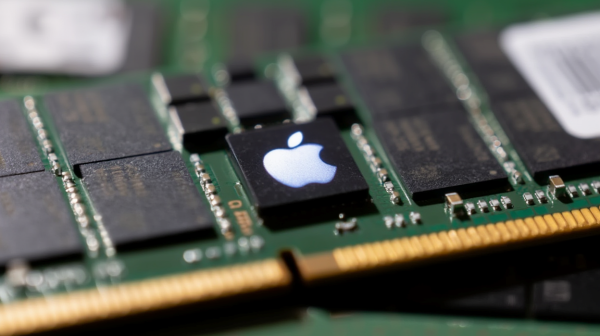
A surge in memory prices could pressure Apple’s profitability, but an analysis said it could in the long run widen Apple’s edge over competitors.
On May 14, online outlet Gigazine reported that Asymco analyst Horace Dediu (호러스 데디우) said the 2026 “memory panic” is not necessarily bad for Apple.
The key is that Apple is not simply a company that buys memory. Apple secures parts for products such as the iPhone, Mac, iPad, Apple Watch and Vision Pro under long-term procurement deals involving hundreds of millions of units. That allows memory makers to draw up production plans and even raise funds for facility investment on the assumption of Apple supply volumes.
Dediu said the “surge in memory prices” that is becoming an issue is mainly showing up in urgent procurement volumes. He said prices for memory that companies try to secure at short notice are jumping more steeply than the basic supplies already under contract. Apple does not buy memory each month at short-term market prices, but rather negotiates baseline supply volumes on the basis of long-term contracts.
That difference becomes more pronounced during supply shortages. Memory and semiconductors are not products that can be supplied in bulk the month after an order is placed. Factory capacity, raw materials, equipment, funding and staffing all have to be aligned years in advance. As a result, memory makers find it difficult to take a hard line in price negotiations with customers that promise large purchases over long periods.
If the situation drags on, long-term contract prices could also be affected. Memory makers, however, must weigh the gains from high-priced short-term sales against the value of long-term business with large customers such as Apple. With the semiconductor market cycling between booms and downturns, it is also difficult to be certain that the current price surge will persist.
Another view is that Apple holds negotiating leverage. In the short-term market, suppliers may appear to have the upper hand, but over a multi-year horizon Apple’s buying power and ability to place steady orders can be a bigger weapon. Suppliers also have to balance selling volumes at high prices now and maintaining long-term business with Apple after market conditions cool.
Competitors may bear a heavier burden. Smartphone makers without Apple’s scale and financial strength are more likely to fail to secure needed memory on time or have to accept higher prices as they are. In that case, product costs rise and profitability can quickly be shaken. The analysis said the more Apple locks up supply first, the more rivals could be pushed into paying higher prices to compete for what is left.
Dediu said Apple can tolerate a drop in gross profit margin to 45 percent from 49 percent, and that 45 percent is not an extremely low level Apple has experienced in the past. He said the more important question is whether competitors can withstand the same situation.
The analysis also raised a possible link to future product strategy. Dediu mentioned the possibility that Apple could step up an offensive in lower-priced iPhones around $499. If Apple can offer an experience close to today’s high-performance iPhones at that price, it could put major pressure on competitors that struggle to make profits even on $800 handsets, the analysis said.
Ultimately, the surge in memory prices is a negative that raises Apple’s manufacturing costs, but it can also create an environment that favors companies with long-term contracts, financial strength and supply-chain management capabilities. The core of the analysis is that the longer component price increases last, the side that becomes more strained is likely to be not Apple but competitors that lack Apple’s scale and procurement ability.
 Yoonseo Lee
yslee@d-today.co.kr
Yoonseo Lee
yslee@d-today.co.kr