
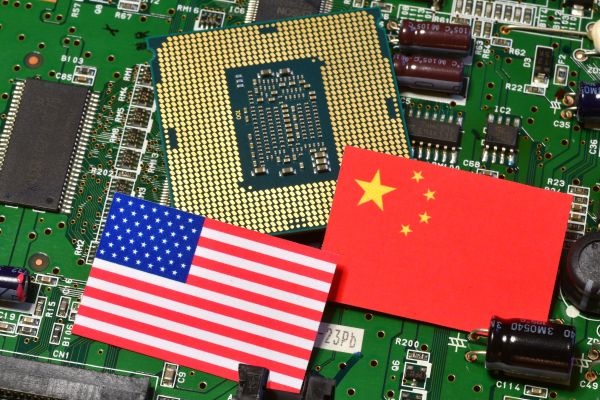
[Digital Today reporter Seung-a Yoo] China's big tech companies said they will expand production and adoption of their own artificial intelligence (AI) chips in earnest this year. The push to localise key AI infrastructure components is continuing even as a possible return by Nvidia to the China market is being discussed.
On May 14, local time, Tencent and Alibaba laid out plans during earnings announcements to expand their use of China-made semiconductors, CNBC and other foreign media reported.
Tencent said capital spending will rise sharply this year. It expects investment execution to accelerate as the supply of chips designed in China expands, especially toward the second half. Tencent Chief Strategy Officer James Mitchell (James Mitchell) said China-made chips are "becoming more available each month" and that supplies of China-made graphics processing units will also increase gradually through the year.
Alibaba is also expanding its use of its own semiconductors. It is deploying its own AI chips in data centres that support its cloud business, and executives said during an earnings announcement that its in-house GPU chip has entered the stage of mass production at scale. Alibaba said in an environment where securing semiconductors is limited, that structure would work in its favour for revenue growth and improvements in gross margin.
Alibaba also suggested selling servers equipped with its chips to firms that build computing and data centres, or jointly building data centres with other companies. That is seen as a move to expand the use of its chips to external customers.
China has pursued a strategy to expand domestically produced chips to achieve AI self-reliance after U.S. export curbs limited access to Nvidia technology. Chinese semiconductor companies such as Moore Threads, MetaX and Huawei have filled gaps left by Nvidia and have recently shown a trend of rising revenue.
Still, it remains uncertain whether supplies of Nvidia chips will resume. Reuters reported that the U.S. government approved purchases of Nvidia's H200 by some Chinese companies, including Alibaba and Tencent, but the H200 is said not to have entered full-scale production yet. U.S. Treasury Secretary Scott Bessent (Scott Bessent) said of a related question, "That's the first I heard of it," and added the matter is under the U.S. Commerce Department.
Nvidia is in a situation where it is hard to fully abandon the China market. Chief Executive Jensen Huang (Jensen Huang) has previously warned that U.S. export restrictions are affecting the company's market share in China. He also recently visited Beijing with U.S. President Donald Trump and attended a leader-level event with Chinese President Xi Jinping (Xi Jinping).
In this situation, whether H200 deals resume is expected to depend on the U.S. stance on export controls and the Chinese government's judgment. Even if the United States formally allows purchases, Nvidia's recovery in China revenue is likely to be limited if Chinese companies do not place orders.
Neil Shah (Neil Shah), a partner at Counterpoint Research, said demand for high-performance chips is rising as Chinese companies shift to agent-style AI that performs more complex tasks. He added that while China's AI strategy is tilting toward domestic products in the training phase, the focus of competition is gradually moving from training to large-scale inference.
 Seung-a Yoo
ysah@d-today.co.kr
Seung-a Yoo
ysah@d-today.co.kr